
Meet the people who want to help you sell your stuff, without Facebook
'Slower than Amazon and less money than Facebook' services aim to reduce waste
One of the most pernicious New York City conundrums is what to do with all the stuff. There is stuff everywhere; it’s always coming and going out of someone’s house, and most of it is perfectly usable, but sometimes the stuff just ends up in a landfill because there’s nowhere for it all to go.
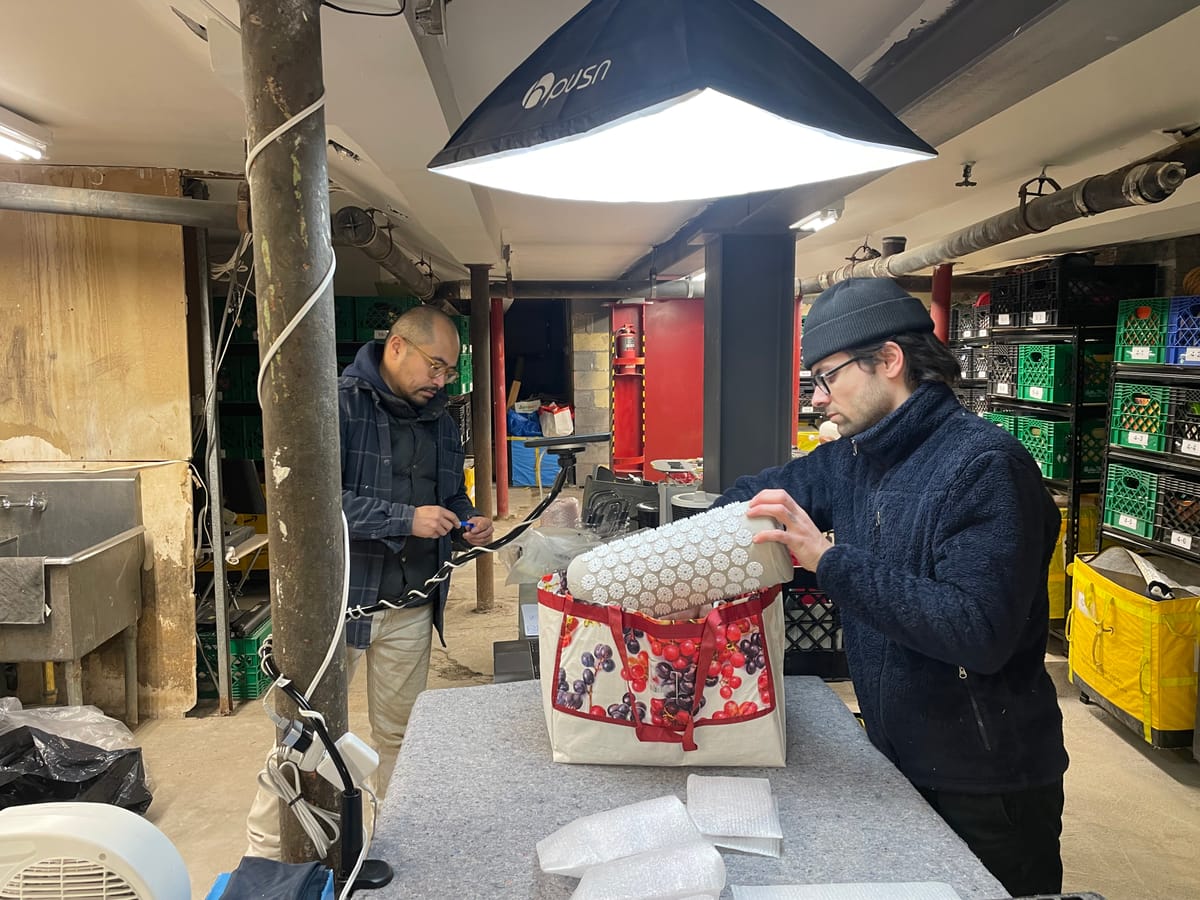
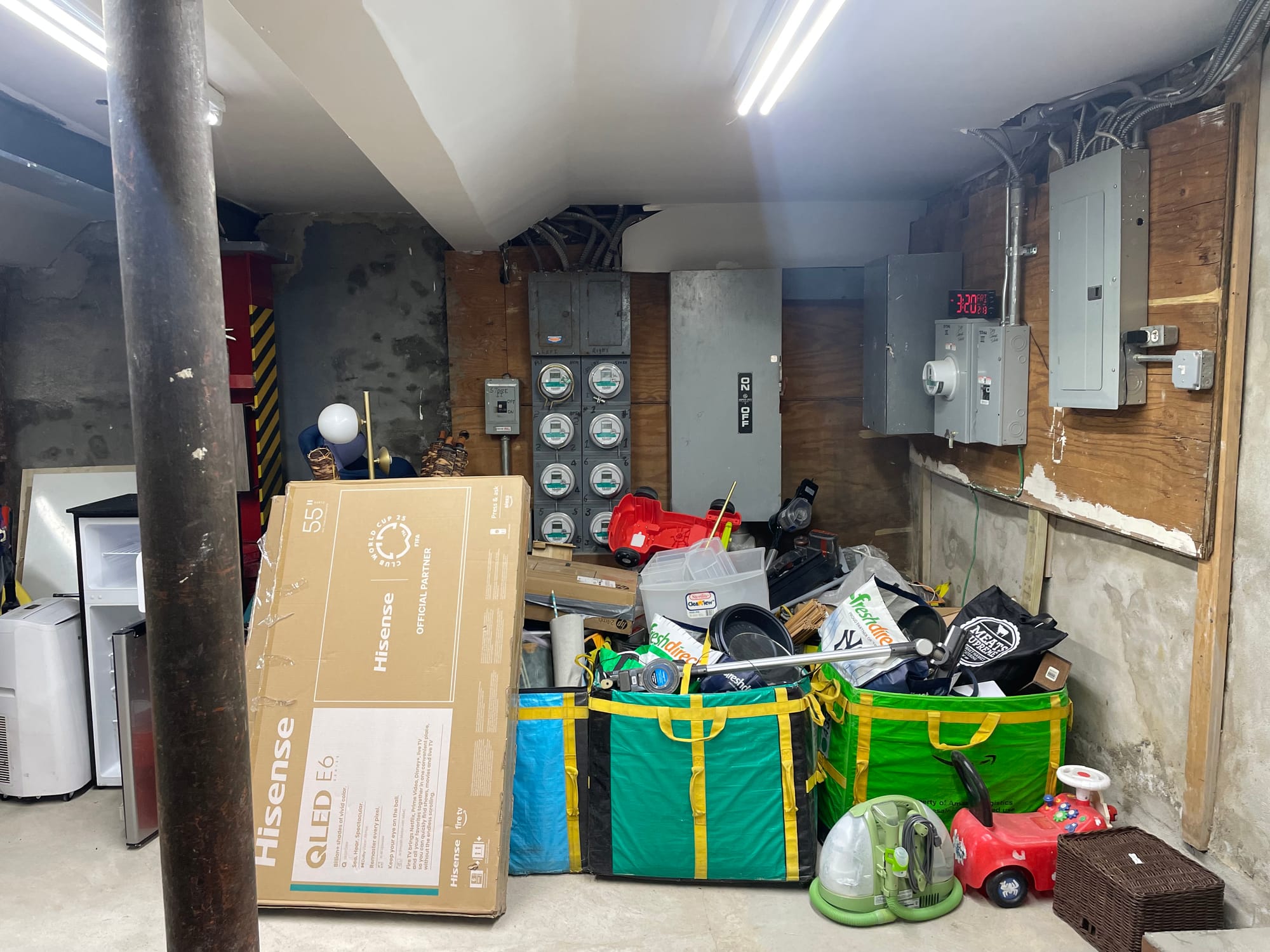
Quentin Maniguet and Steven Weiss are creating a new way to deal with the problem of stuff, and it’s one they’ve faced firsthand, even as professionals in the world of stuff. On a recent January morning, their basement unit was flooded during the wicked cold spell, putting all the stuff in peril. The small unit is packed with shelves, a sorting area, mini photo studio and a collection area. Items poke out of repurposed Amazon delivery bags and reclaimed Fresh Direct sacks. The burst pipe ruined some of the stuff, they told me on a video call, but there was always plenty to go around.
Maniguet, who is from France, and Weiss, a Staten Island native, run a company called Cues that aims to get no-longer-wanted items from one home to another in Bed-Stuy with minimal friction, and zero engagement with Facebook. The two met at a tech company job but realized they both had a shared interest in energy and waste. Their company (whose name comes from a combination of their first names) grew from a compost-collection startup in 2023 to a now full-time stuff collection and reselling operation. The goal is to eliminate more trash from the landfill, save energy and keep things people actually need in the neighborhood, so they’re not constantly ordering new products from online retailers.
“There's a bunch of stuff in people's homes. Most of it exists. You should just try to get it secondhand and make that very easy,” Weiss said. “Like, less of the treasure-digging through a crate and more, just … you can get a lot of stuff with some ease.”
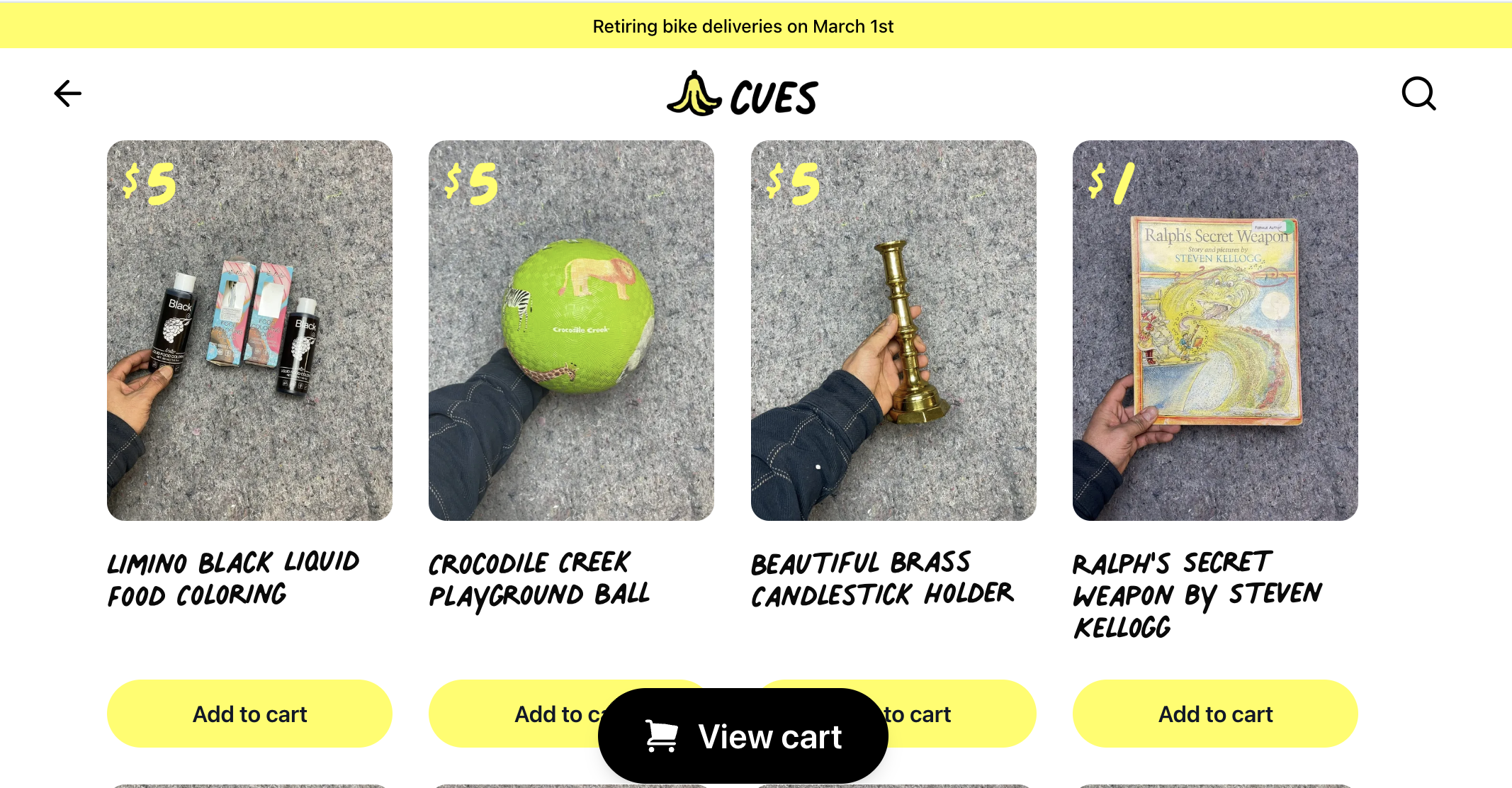
The company works as a centralized version of both a stoop sale and a curbside free-giveaway box. They collect items from around the neighborhood, either by bike or Uber courier, and sort them into what can be sold and what needs to be recycled.
👋 hi there free reader: We hope you enjoy our free work but consider supporting us by becoming a member: you'll get exclusive content, FOMO Calendar access, cheap tickets to our events and more!
Generations of New Yorkers have tried to solve the issue of stuff: we’ve opened, and then priced out, thrift stores in every neighborhood; started Freecycle and Buy Nothing Groups, followed Instagram accounts highlighting stoop finds across the city and become professional Facebook Marketplace hagglers. The problem with all these efforts, well-intentioned as they may be, is that they don’t really solve the problem of too much stuff. It’s nice to pair your old charging wires with someone from the Buy Nothing group but it’s hard to really crank out the volume to clear your closet or bedroom before a move. Depending on your neighborhood, there’s usually nothing as efficient as just putting it all on the curb, but that doesn’t always pair the stuff with someone else who actually needs it, or prevent it from getting swept into the garbage eventually.
Cues is one of the companies in the city also trying to deal with one of the hardest parts of getting rid of stuff: the dreaded “hi, is this still available?” reply that plagues every attempt to sell or give something away on Facebook Marketplace. Cues puts up new listings in daily drops around lunchtime and handles the pickup process, more like a traditional store. The site is user friendly and easy to navigate. The items seem pretty good; I found myself shopping for deals while just poking around the site and talking myself out of buying a Nelson Rockefeller decanter for $5.
“We try to make this very smooth end to end,” Weiss said. “We try to make sure the buyer is real. We try to make sure the buyer knows where to go. We try to make sure the buyer shows up. We try to make sure the buyer, if they don't show up, at least they'll get it eventually. The price should be right.”
Cues operates two arms: it will come and help sell your stuff that you’re just trying to get rid of, what Weiss and Maniguet called the 4 Ms: moving, merging, maintenance or misery. A move is a time to downsize or declutter, but there’s often not time for all that, so stuff ends up on the curb or in the trash. The Cues team comes to a house and sets up a virtual moving sale, taking photos of items and pricing them to move. Cues takes a $5 cut from each item sold.
The other arm is just about finding a home for what they collect: instead of calling junkers, trashing it or hoping it gets scooped from the stoop before it gets peed on by a passing dog, the Cues team collects and and tags it in their basement space for resale. Mostly these items are donated for the good of upcycling them, but there is a chance for some reward: donors get entered into a weekly lottery to split the profits of whatever is sold, which can sometimes be about $200.
“The typical person who does this is basically like a super busy mom,” Weiss said. “For the most part, people are just like, I gotta go. And those people are, at this point in their journey of, like, the stuff they're good, they just want it out their door.”

Cues jokes that its model is “slower than Amazon and less money than Facebook,” but thinks of itself as a “neighborhood warehouse.” The prices are set to move so they can rehome the goods, and keep stuff moving from their shelves.
“It's really a circulation business,” Weiss said. “So we just view that every home is a shelf and it has stuff. And we should figure out how to get this stuff on the internet. And people should be able to just be like, Yeah, I'm just checking out with my neighbors, and it's pretty straightforward to go and, like, pick it up, grab it, get it delivered, whatever it is, fulfilled.”
It has been notoriously tricky to break people of the Facebook habit when it comes to getting rid of things, even if people don’t use the social media site for much else these days. We wrote last year about how hard it is for Buy Nothing Groups to leave the site, which provides a simple architecture for their needs, even as some group members have to hold their nose and click past AI spam and political rants from high school friends to use it (Buy Nothing operates a standalone app too, but it's not as well used as the classic Facebook groups). At best, it’s a scheduling musical chairs: did any of the nine people who messaged you about the couch being available actually mean it? Are they actually coming? Are they creeps?
Fort Greene resident Benjamin Schachter also felt the musical chairs problem and also wanted to do something about it.
“My wife and I get a lot of things for free and secondhand on the internet,” Schachter said. “It’s a terrible experience. It’s truly awful.”
That system isn’t built for people who are looking to get rid of 20 to 30 things at a time, he said.
“It just turns into a nightmare of scheduling and coordination. You just get so frustrated to the point where, ‘You know what? I'm just going to put it on the curb,’ ” he said “It’s not worth it any more, there’s so much friction.”
So after some burnout in his professional tech career (one boss literally “cancelled Christmas,” he said), Schachter decided to tackle the world of stuff. He created an app called Treasure It that he advertises as “better than free.” It manages the scheduling and pick up process, and lets you queue other interested users in case one falls through. The idea is to eliminate the back-and-forth of the “is this still available?” messages and focus on moving items from person to person faster. The app lets you create virtual communities as well, so you can set up a sharing community just for your block or building.
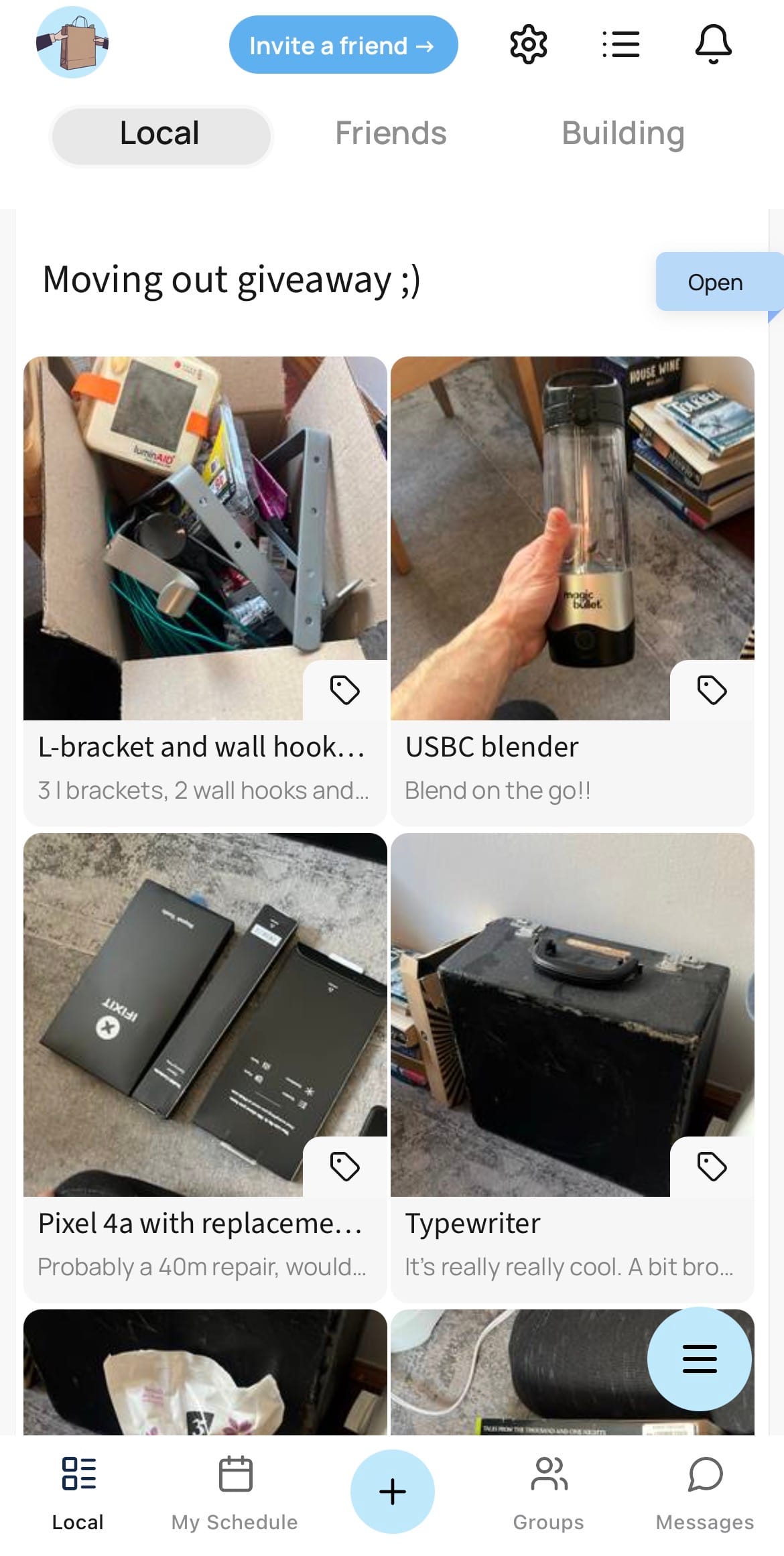
“All that cognitive load just kind of disappears,” he said of the app. He said the service has grown to over 1,600 users and more than 1,000 items moved since launching in August.
Treasure It and Cues are tech-forward attempts to fix the problem of stuff, which has often been an analog process in the city. Buy Nothing groups are Facebook-dependent but also dogmatic in their principles, typically with shades of anti-capitalist and anti-consumption language that are at odds with the Facebook platform. Schachter at Treasure It wants the app to include paid items for sale as well as free ones, which he hopes will let him turn it into his full-time job.
Thrifting apps have notoriously struggled to turn profit, even as the demand for secondhand goods has risen. The Cues team works full-time and said they are able to keep their operation efficient by focusing just on Bed-Stuy; they’re at what startups call the “ramen profitable” stage; the goal is to move more items — not increase prices — to make more profit.
“The nature of making a dent in recycling requires moving a lot of volume,” Weiss said.
Personally, I deal with the fatigue of tech when it comes to getting rid of my own stuff. I’ve been in plenty of Buy Nothing groups and claimed lots of items from them, but rarely, if I’m being honest, feel motivated to post something to one. It’s always easier to put a box of free stuff on the curb than it is to upload and tag and have to log into the odious Facebook app to check the messages (not to mention having to download the separate, more equally as odious, Messenger app on your phone to communicate with them).
But I also have watched my stuff be junked in horror. In my one major apartment move-out a decade ago, myself and three roommates were left with clearing out our loft space that had accumulated junk since probably the Clinton administration, or before. We tried to lug donations down five flights of stairs to cart to the Salvation Army down the block, but it was like scooping the ocean with a pen cap. We gave up and called junkers. This cost us thousands of dollars, and many hours of work. It was definitely not ideal; but we were truly out of time. It’s possible one of these new types of services would have been able to help a little.
“The mission of Treasure It is to keep things out of the landfill. That’s our sole cause,” Schachter said. “The free thing is the closest to being thrown away.”
Weiss with Cues said their goal is to cut down waste but not just physical landfill waste; they’re also focused on the time, energy and patience that are usually wasted in this process. Those things are as much at a premium as actual space in the city. “Forgetting about like, the geopolitical stability issues that have gone on with misinformation, just the sheer act of everybody clicking, nobody showing up, other people sitting around and waiting, holding their thing, being like, ‘Fuck this,’ and then throwing it outside in the end,” Weiss said.
They hope to expand Cues to other neighborhoods, with the goal of keeping it a neighbor-to-neighbor sharing circulation service above all.
“We're trying to produce and live dignified work that pays all right, and that's it,” he said. “I don't think it's that complicated, just a lot of work.’
As for getting people off social media and on to another service, there is some hope: both Cues and Treasure It said they tried advertising online and didn’t get great results. Instead they got a lot of business from something analog and old school, which is how I found out about them in the first place: posting flyers around the neighborhood.
“Look, if you flyer your own block, all the poles on both sides, let's go around where your base exists, like that, and you'll see the results,” Maniguet said. “People will call you on these blocks.”


Comments ()