
Let the Pinnacle case be your inspiration to start a tenants union
'People can just start a tenants association the same way you can start a book club.'

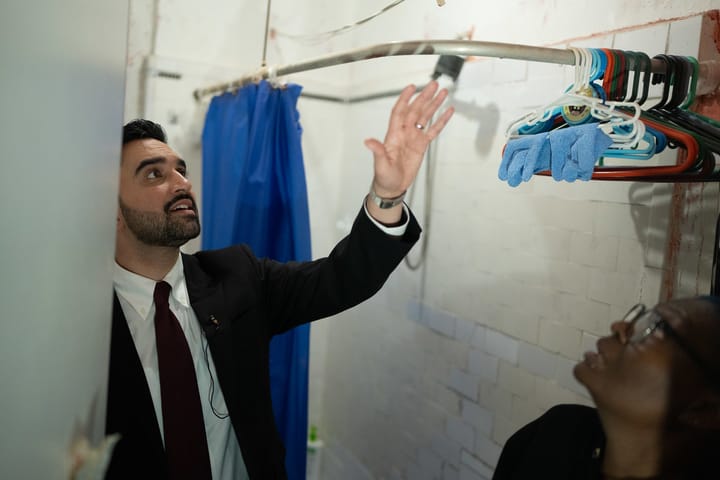
Something we’ve always hoped we’d have an opportunity to say: It’s a bad time to be a bad landlord. Following his inauguration ceremony and block party on Jan. 1, Mayor Zohran Mamdani used his first day in office to visit a Flatbush building owned by the Pinnacle Group, a particularly notorious landlord in a city that’s full of them.
The mayor also used his first day in office to sign an executive order with plans to revive the Mayor’s Office to Protect Tenants, saying, "If your landlord does not responsibly steward your home, city government will step in.”
But years before the issue caught the eye of an incoming mayor, the strongest (and only) advocates for Pinnacle buildings were the tenants themselves. Residents of Pinnacle properties have been working together for the better part of a decade to pressure their landlord to fix issues like endlessly broken elevators, collapsing cabinets and ceilings, and lack of heat and hot water, to name a few greatest hits. This groundwork proved essential last May when Pinnacle announced its bankruptcy, prompting tenants to organize into the Union of Pinnacle Tenants.
Unlike the more formal world of labor unions, a tenant union is essentially any group of tenants banding together for improved conditions and can be organized by building, by ownership (i.e. people living in different buildings owned by the same landlord), or even by neighborhood.
“The Union of Pinnacle Tenants actually grew out of work we were doing in the Crown Heights Tenant Union; when bankruptcy hit, we were already organizing in my building along with 13 other buildings in Crown Heights,” said Zara Cadoux, a Pinnacle tenant and an organizer with both unions. “We realized how freaked out people were, and already had an organized base, so we started to reach out to other buildings we didn’t know. There was such a big response of people say, ‘We want to be in on this, we want to protect our homes.’”
Primarily, tenants were concerned about a forthcoming bankruptcy auction of 5,200 rent-stabilized units owned by Pinnacle, and what might become of their residents under new ownership. The auction was slated for Jan. 8 , just a week into Mamdani’s term, and in spite of the administration’s efforts, the sale went through to Summit Properties, a management company that just this week appeared on the Public Advocate’s latest “worst landlords” list.
Still, the combined pressure from the mayor and the tenants ended with major concessions from Summit, notably a commitment to $30 million worth of repairs in the apartments over the course of the next six months.
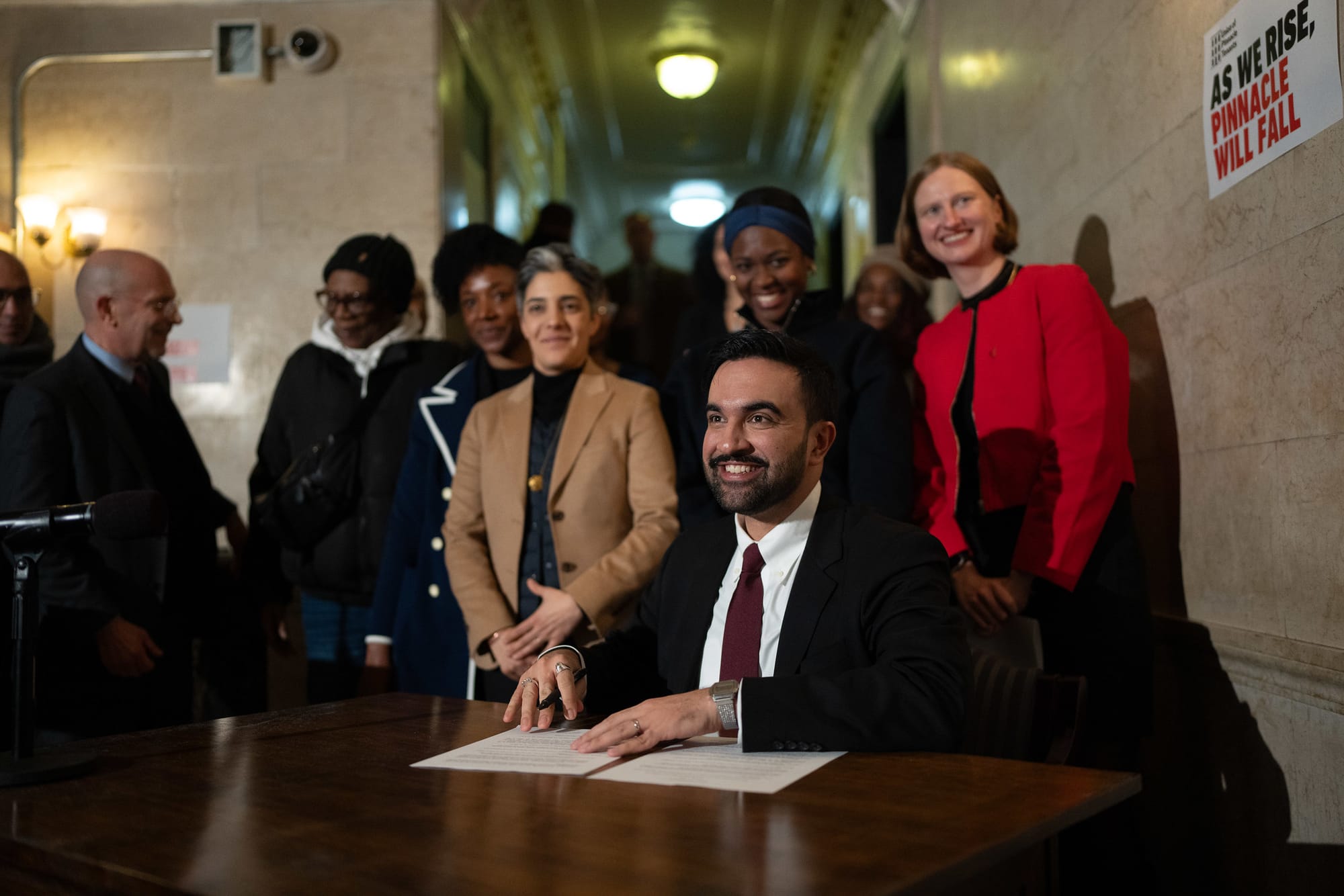
“I totally disagree with the characterization that Mamdani ‘lost’ [in the fight against the Pinnacle sale],” Cadoux said. “Because of his involvement we won major concessions. Which are not very typical in bankruptcy cases. It’s like night and day from dealing with the Adams administration.”
City Hall isn’t just interested in this one fight either, with the Mamdani administration highlighting the unions as a “key partner” in upholding housing law.
“No matter the building owner, tenants unions have an important role to play in ensuring tenants know their rights and pushing the city to intervene when building owners are not upholding their legal responsibilities,” Cea Weaver, the director of the Mayor’s Office to Protect Tenants, told The Groove in a statement.
Between the pressures of the never-ending housing crisis and the enthusiastic support of a new mayoral administration, this is as prime a moment as ever to start a tenant union of your own. Below, some expert advice on how — and why — to get started:
Getting started (and starting small)
Seeing highly publicized court cases involving thousands of unionized tenants can make the process of starting your own tenant union seem daunting. But every organizer we spoke with emphasized the importance of starting small.
“A good place to start is an intuitive one: talk to your neighbors,” said Amy Collado, lead organizer Bushwick Housing Independence Project. “We’re really focused on building relationships, and tenant unions are just another way of building community, which a lot of times can be hard for newer folks, people who are shy, and people who may not be privy to what their rights are.”
If you and even just a handful of your neighbors are in regular communication, you’re already better positioned to handle new problems as they come up, or gather information about existing ones. “You have to start somewhere to connect the dots, ‘Maybe it’s not just me. Maybe we should bring this to the landlord and do it together,’” Collado told The Groove.
Unlike labor unions, which typically organize under larger umbrella organizations like the Teamsters Union and eventually require formal company recognition and contract ratification, you and your neighbors are more or less a tenant union once you say you are.
“We have this idea of a union or a tenants’ association as being this more elaborate or at least formal bureaucratic thing,” said Cora Metrick-Chen, an attorney with Take Root Justice, which provides legal support for community organizations across the city. “But it doesn’t require the bureaucracy that a labor union typically has. People can just start a tenants association the same way you can start a book club.”
Knock on neighbors' doors, hold regular meetings, figure out your system for making decisions as a group, Metrick-Chen said, and eventually, try to recruit more tenants to join the cause. (This can feel easier said than done, and for first-time organizers unsure of the best way to go about all this, Build Up Justice has a solid organizing tip sheet.) “But there’s no formal process by which to do that, no certifying, and no certifying threshold.”
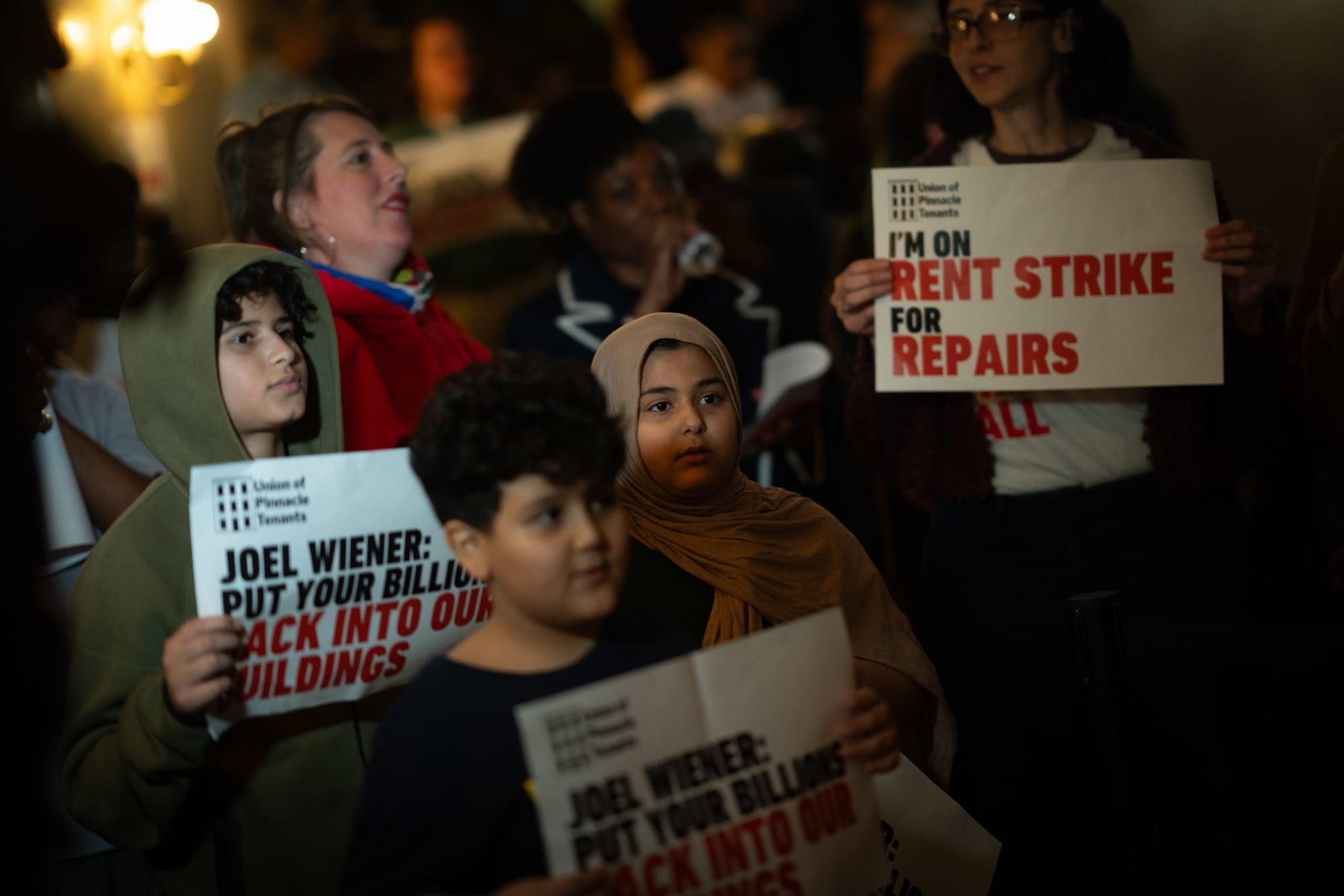
This can also look like getting involved with tenant unions that are organized by neighborhood versus building ownership (the Crown Heights Tenant Union and Ridgewood Tenant Union, for instance). These often double as important sources of community connection and mutual aid, and can later work in tandem with landlord-specific unions as well, Cadoux said.
“The Union of Pinnacle tenants would not have been possible without the very slow and intentional work that was done in Crown Heights over many years,” she said.
One pro tip as you look to build connections and momentum?
“Have regular meetings, but also have celebratory events,” Metrick-Chen said. “Doing activities together that make the group more cohesive will contribute a lot to the longevity of the group, it doesn’t have to be fighting all the time.”
Know your rights
Unsurprisingly, one of the primary obstacles to tenant organizing is the fear that if the landlord finds out, you’ll get kicked out of your apartment. So to be abundantly clear: your rights to both complain to the landlord and organize among other tenants are legally protected, and if the landlord tries to retaliate in any way, they’re breaking the law.
Real Property Law 230 explicitly protects “the rights of tenants to form, join or participate in tenants’ groups” and bars landlords from “interfering,” harassing, penalizing or punishing tenants who participate.
“I think a lot of us don’t know our rights, and are afraid that the landlord can throw us out at any moment if we complain or raise a fuss,” Metrick-Chen said. “You have a right to complain under various city and state housing laws. And beyond that, tenants are much more powerful when they band together.”
In their overall guide on tenant union organizing (which also includes tips on meeting structure and potential actions and demands), the Met Council on Housing has a handy FAQ on legal rights that you can share with neighbors, as well. The Union of Pinnacle Tenants has its own organizing and know-your-rights tip sheets online, as well.

“Even naming the laws tends to give people peace of mind,” Collado said. “And talking to more vulnerable people in the building — for instance people who might be undocumented — about what their fears are, who do we need to bring into the room to answer your questions? And what risks do they want to take or not take, like leaving certain names off letters to the landlord.”
Level-setting understanding of legal rights along with everyone’s respective level of risk tolerance is an important starting point.
One thing to consider: Rent-stabilized tenants have always had a certain level of protection from eviction proceedings, and Good Cause Eviction laws passed in 2024 mean many market rate tenants have protections as well.
But for tenants not covered by either, “There’s still a risk you have to take when you think about organizing,” Metrick-Chen said. “That’s why as lawyers we like to see people organizing together. It’s much harder for a landlord to evict 17 market-rate tenants than it is one.”
The potential payoff
Organizing can be a slow and occasionally frustrating process, and to stay motivated (or to get new neighbors on board), it helps to have a clear vision of the benefits.
Some of that is case by case, and it’s worth working with your neighbors early on to define what success might look like for your specific group, Collado said. Often, this doesn’t come in the form of headline-grabbing court cases, but day-to-day quality of living improvements.
“One tenant association I worked with really wanted to prioritize getting their porter to work more hours, having more supplies like garbage bags, and a second person to work on weekends to clean up trash [and prevent vermin],” Collado said. “That’s a win that has nothing to do with housing court.”
Before Pinnacle and its eventual bankruptcy ever became a legal issue du jour, organized residents won significant improvements just by virtue of putting collective pressure on management through actions like mass 311 reporting and even rent strikes. “I’ve seen being part of a union make a really big difference for me and my neighbors,” Cadoux said.
“We initially went on rent strike because our elevator had been out for months, which is a tactic we’ve seen through the portfolio and other rent-stabilized buildings to push out older residents,” Cadoux told The Groove. “One of the long-term residents was basically trapped in his apartment on the fifth floor, and had to call the fire department to carry him up and down the stairs for doctor’s appointments.”
“We tried everything first, then we went on rent strike and they immediately started fixing the elevator,” Cadoux said.
Public actions like rallies and social media campaigns have also proven an effective means of putting pressure on landlords as a group without ever having to step foot in housing court or even necessarily hire a lawyer.
“Do your research finding out who your landlord is, finding out what properties they own,” said Metrick-Chen. “We’ve had clients hold rallies and press conferences outside rallies of business, even homes. Drawing the public eye to that has been effective at getting landlords to do repairs and worry about harm to their reputation.”
Taking small steps and building solidarity with your neighbors can also prove an effective antidote to the terror and paralysis of the current moment.
“I think people need to not get so nervous about the formality of what it means to form a tenants union, and see it as a better communication system among their neighbors to address issues,” Collado said. “There’s value in wanting to organize hyper-locally in your building. At the end of the day, that’s where you’re going to get the most support for your specific issue, and the everyday person has a lot more opportunity to make an impact when it’s in our own building.”
 Kate Mooney
 Virginia K. Smith

Comments ()