
New York’s Revolutionary War history is cooler than Boston and Philly’s, actually — here’s where to find it
A guide to what to do with yourself once you've finished the new Ken Burns
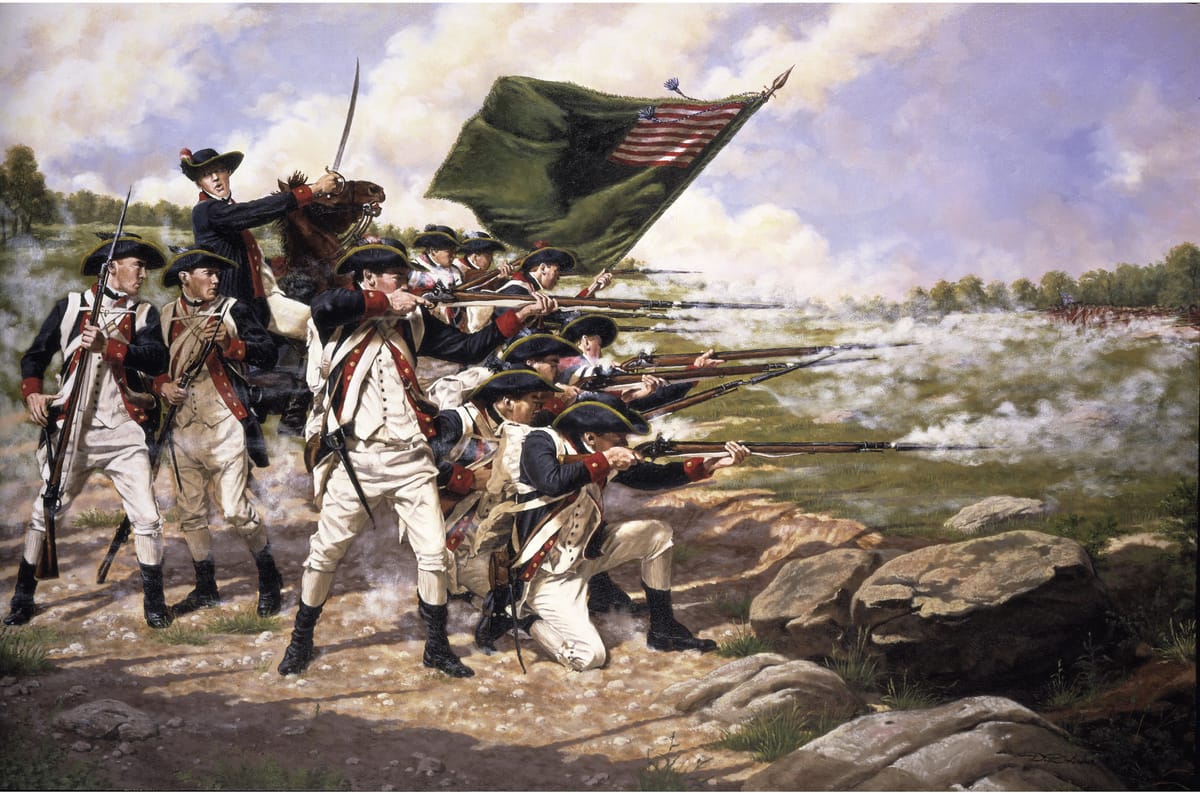
We’re rapidly hurtling toward the United States’ Semiquincentennial in 2026, and Revolutionary War fever is spreading like wildfire. Not because the American project is going so well and we’re all so excited to celebrate it, but rather, because Ken Burns unleashed another absolute heater last month with his characteristically exhaustive 12-hour docuseries The American Revolution.
As you’d expect, the series digs into uncomfortable truths behind some of our favorite national myths and narratives, and if we’re looking at the local angle, it provides an opportunity to reexamine a specific one: the idea that Boston and Philadelphia are the real seats of Revolutionary War history, and New York’s role in the whole thing isn’t that important or interesting. Look, those cities may need the attention more than we do, but that doesn’t make it true!
“When people think about the Revolution, they don’t think about New York; they think Boston, Philly,” said Peter-Christian Aigner, director of the Gotham Center for New York City History. “Even people who are aficionados of New York City history are surprised to learn how central New York was.”
This issue has been a bugaboo of historians for decades (Ken’s brother, Ric Burns, the filmmaker behind New York: A Documentary Film also said as much when Dave interviewed him this fall) and experts ascribe plenty of reasons for it. For one, Boston and Philly have made concerted ongoing efforts to tout their historic status, whereas New York tends to be relentlessly focused on whatever’s coming next.
“That’s the role we’ve played for 200 years in the U.S., being the center of what’s important now, what’s going to be important in the future,” Aigner told The Groove.

Support independent local journalism. Become a member of The Groove today and you will unlock perks, discounts and more!
While Boston and Philadelphia receded somewhat in national importance over the centuries, New York only became larger and more powerful, Aigner said.
“That means every bit of real estate in New York is super valuable and nothing lasts,” he said. "Old buildings go down and it’s always a struggle for preservation, whereas in Boston and Philadelphia, you can still walk colonial streets.”
Another, more literal reason behind this state of affairs: a good chunk of New York’s Revolutionary War history burned down in the Great Fire of 1835.
“We’re coming up on the 190th anniversary of this fire, which destroyed about a quarter of the city in Lower Manhattan, mostly buildings from the 18th century,” said Greg Young, co-host of The Bowery Boys podcast, which ran a full episode about the fire back in 2020 (they also have a roundup of Revolution-related podcast episodes here). “That’s why it’s so difficult to find Revolutionary War sites. You’ll see a plaque here or there, but pretty much all of the wooden buildings below Wall Street were destroyed.”
The lack of civic support or infrastructure for this part of the city’s history has real economic consequences, according to Aigner. The creation of Boston’s Revolutionary Trail in the 1950s was an intentional development move that saw historic tourism increase tenfold within a decade, and now rakes in billions of dollars per year.
 Dave Colon
“In terms of dollars and cents, Boston and Philly get something like $6.5 billion from this every year; people who do historical tourism are the fastest growing part of the tourism market,” he said. While those cities get around five million Revolution-curious tourists annually, New York draws in around 300,000 to 400,000, “mostly to Federal Hall, Trinity Church, etc.,” he said.
Even if you’re not overly concerned at the prospect of New York somehow not having enough in the way of tourism, the city’s Revolution-era history is worth diving into on its own merits.
Some of the war’s most pivotal battles took place in New York, as did some of the first meaningful early unrest against Britain— the Boston Massacre was a protest in solidarity with New York’s Battle of Golden Hill, a 1770 conflict between British soldiers and the Sons of Liberty that is considered some of the earliest violence between the two sides. (The site of the conflict is currently a nondescript alley in Lower Manhattan.) New York’s Revolutionary history is also messier; the city was captured by the British early on, and served as a military stronghold for the opposition for much of the war. The area also had a sizable population of loyalists, as well as a more racially diverse makeup than other parts of the colonies, meaning a good amount of disagreement and internal conflict over support for the war.
“New York is the best place to look at because of that division and diversity,” Aigner said. “Far from being an outlier, the city is the best representation of what the revolution is actually about for the country at large, which is essentially the country’s first civil war. Whichever racial or ideological group you want to understand, New York gets a better view than other cities.”
Once you’ve finished your 12-hour date with Ken Burns, we’ve put together a starter pack of historic sites and resources to kickstart your New York-centric exploration. Who doesn’t love an opportunity to learn a little local history while simultaneously getting a fresh excuse to big dog Boston and Philly?
Look to the parks
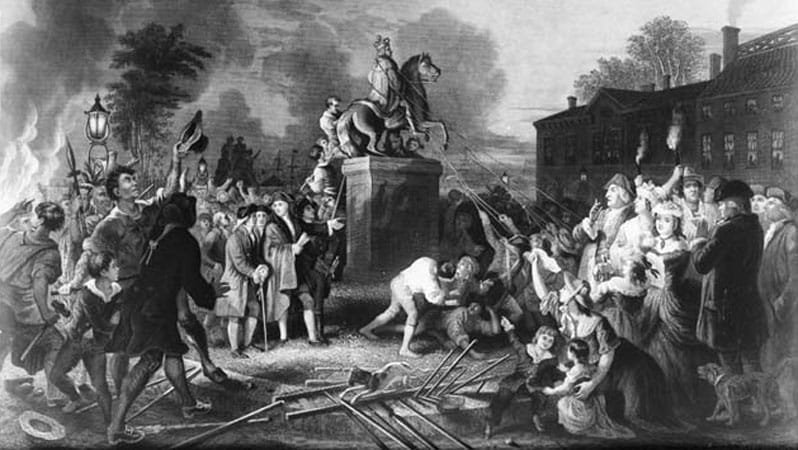
A lot of the city’s “most meaningful” landmarks have survived by virtue of being located in parks, according to Young, and the Parks Department does in fact maintain a handy list of Revolutionary War sites at parks in every borough other than Queens (the only borough with a specifically imperial name…. coincidence?). Though Bowling Green in Lower Manhattan is a classic — an angry mob toppled a statue of King George III there five days after the Declaration of Independence — many of the biggest standouts are located in Brooklyn.
“Green-Wood Cemetery is the highest point in Brooklyn and was used as a lookout site; there’s a memorial at the very top point,” Young said. The cemetery often hosts annual events commemorating The Battle of Brooklyn (also known as the Battle of Long Island or the Battle of Brooklyn Heights), an event considered to be the largest battle of the war.
“Another location that was part of that battle was the Old Stone House in Park Slope, which is part of [Washington Park] today,” Young told The Groove. “It was where a huge part of the battle happened, and hundreds of soldiers died around this particular area.”
Prospect Park has several memorials, which were baked into the original design plans by Frederick Law Olmstead and Calvert Vaux with an eye to preserving sites of the historic battle, Young said. There are markers denoting the location of Battle Pass, a key route used during the Battle of Brooklyn.
“In many cases the forests that are there now would have been there during the war,” Young said. (Untapped Cities has a good rundown of Prospect Park war memorials — including the huge monument to the Marquis de Lafayette at the 9th Street entrance).
“We don’t have battlefields and things like that; we do have a lot of these markers, and Brooklyn has the most,” said Young.
One other notable standout: the Prison Ship Martyrs Monument in Fort Greene Park.
“When the British occupied New York during the war, they would ship prisoners of all different types to New York on these terrible prison ships in the area where the Brooklyn Navy Yard is today,” Young said. “Hundreds of people died of disease and starvation, and their bodies were dumped into the bay. More people died on prison ships than in any actual battle of the war.”
After the war, the bodies were excavated and relocated to the memorial in the park. “It’s one of the most moving of Brooklyn’s Revolutionary War sites, and a really haunting story,” Young said.
 Dave Colon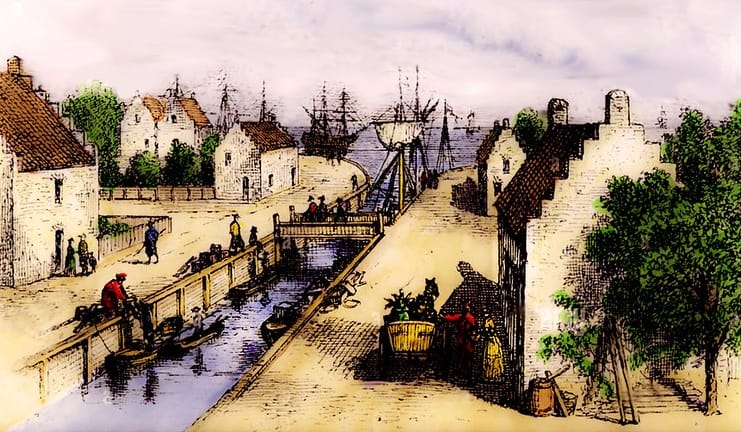
Head uptown — and to the outer boroughs
Aside from Brooklyn’s parks and plaques, if you’re looking for historic sites outside of the Lower Manhattan core, there are plenty to be found uptown, in the Bronx, and even on Staten Island.
The Morris-Jumel Mansion in Washington Heights is one of the city’s most famous historic houses, and was used as a headquarters first by George Washington and his troops, and later by the British army after the city was taken under their control. The surrounding area was the site of the Battle of Harlem Heights — Washington’s first significant military victory in the war — and Bennett Park features both a commemorative marker for the battle and a replica of a Revolutionary-era cannon, Young notes. Farther north in the Bronx, the Van Cortlandt House (now an active museum) similarly served as a headquarters for both American and British troops at different points during the war.
True Revolution real-heads should also make the trek to Staten Island to visit The Conference House.
“It’s at the very southern end of the island, and because it’s so remote, it’s really well preserved, unlike a lot of other places in the city that have gotten bulldozed over,” Young said.
At one point the home of a British naval captain, the house earned its current name by serving as the site of a 1776 conference between Benjamin Franklin, John Adams and a British general to discuss the possibility of ending the war.
“It didn’t work, but it’s a sliding-doors moment of what would have happened if [the talks] had succeeded,” Young said.
Take yourself on a tour
We’ve spent a lot of time here on outer borough options, but much of the colonial city was indeed concentrated in Lower Manhattan (“There were 20,000 people crammed below City Hall, some of the richest people in the 13 colonies living cheek to jowl with some of the poorest,” as Aigner put it), and there are still a number of must-see historic sites down there, in spite of the losses from the 1835 fire.
The Fraunces Tavern is a well-loved favorite, and, as Young puts it, “Is a good starting point because you can eat and drink afterwards.” (It also served as a filming location for part of Burns’ series.) The Fraunces is famously where George Washington gave a farewell speech to his officers at the end of the war, and their on-site museum (also a must-visit) hosts re-enactments on the anniversary of the speech.
For the full experience of Lower Manhattan sites, the Gotham Center has created its own Revolutionary Trail, which starts at the Battery and ends at Federal Hall (yes, the Fraunces is a stop). The 90-minute, 16-site tour is available online and as an app, which is about to get an XR (“extended reality”) upgrade courtesy of Ubisoft, the company behind games like Assassin’s Creed.
“The goal was always to try to get around the problem that New York has in terms of the colonial infrastructure being gone,” Aigner said. “They’ve worked with us on digitally recreating the historic streetscape of New York City, so users can actually see the colonial-scale city and get a sense for what it was like to live in Lower Manhattan at the time.” The updated version of the app is slated to launch in May, timed to the opening of a related exhibition at the Museum of the City of New York.
Exploring the city’s Revolution-era history is a bit of a DIY, choose-your-own-adventure affair for now (Untapped Cities and the New York Historical Society also offer good starter packs of sites to scope out). But we’d make the case that it’s worth a little extra effort, especially if it means we can stage a revolt of our own, overthrow Boston and Philly, and claim New York’s rightful place as a Revolutionary War Town.

Comments ()