At a marathon reading of ‘The Power Broker’ this weekend, Moses’s critics consider the incoming ‘City of Yes’
Robert Caro’s epic contextualized Robert Moses at his peak, what can a 66 hour live reading tell us about what comes next?
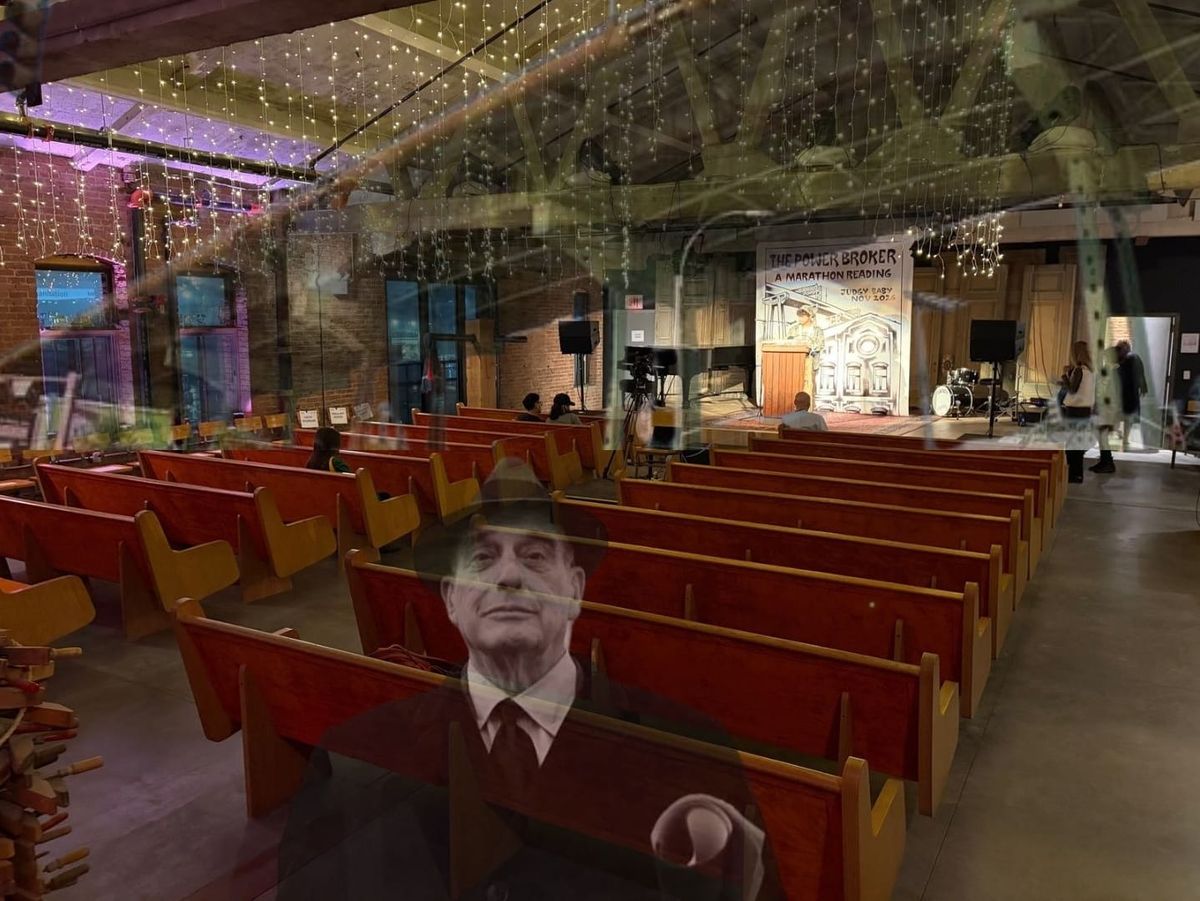
It’s 12:15 in the morning. Sitting on the third floor of an industrial warehouse a dozen or so audience members watch complete strangers recite the words of a 1162-page book that is more than 50 years old. Every few minutes a few trickle back downstairs, searching for coffee or booze, and a few more replace them. Each time a reader completes their 10-minute portion, the assembled listeners applaud.
A marathon reading of Robert Caro’s Pulitzer Prize-winning tome, The Power Broker: Robert Moses and the Fall of New York took place from 7 p.m. on Thursday until just after 1 p.m. on Sunday. Four hundred volunteer readers, each speaking from a podium in front of church-like pews, were given a 10-minute time slot throughout the four-day event rather than a specific section of text.
The event was held in the upstairs of JudgyBaby, a new venue just a few blocks away from where the Gowanus Parkway veers left and crosses the canal. The elevated highway — like many across the five boroughs — can be credited to Robert Moses.
Brad Vogel organized the reading and is director of special projects at Judgy Baby. He said the original plan for the event came from a reading group he led in 2025. Over 10 weeks he taught the book to a group of 21 people.
“At some point during the course of that I said, ‘wouldn’t it be crazy if we did a full marathon reading of The Power Broker?’ ” he said. “And instead of people saying ‘no that’s ridiculous,’ people were actually excited.”
Vogel sees the book as a crucible, one that, “people really need to travel if they want to understand the nature of things here in New York City.”