
'The revolution needs your ears:' the case against wearing AirPods all the time
Constant yammering in your ears isn't just bad for your brain, it's making public spaces less public
I got new AirPods for Christmas after years of trying to hold out with my rapidly dying old pair. They came with a new feature that I found equally technologically revolutionary and psychologically horrifying.
The new models come with an option for something called “personalized volume,” which raises or lowers the volume of whatever’s coming out of your AirPods depending on the environment around you. That means when a car alarm starts going off or a loud truck bangs on by, the volume on your podcast will tick up a few notches to compensate. That also applies to train noise, human voices and, in some cases, your own laughter.
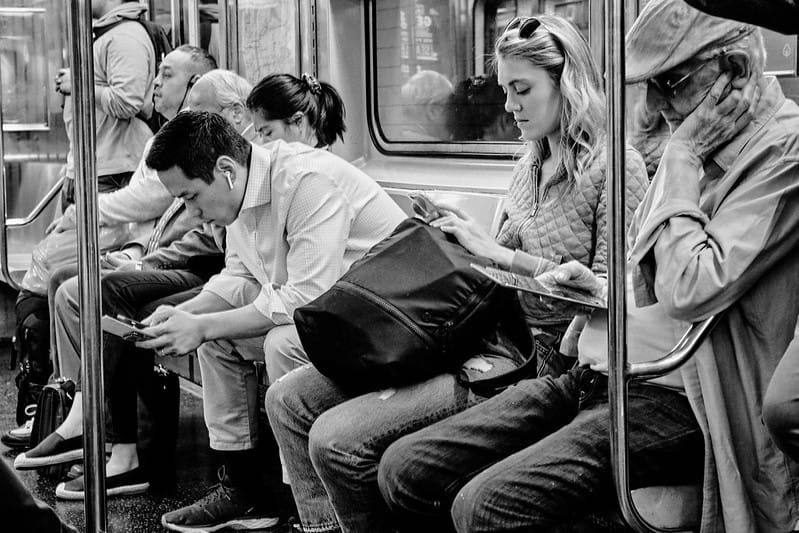
This is a technological leap I had never even thought was coming, one that's designed to keep you locked in to your audio without having to jump back to catch the part you couldn’t hear when a pack of screaming teenagers entered the train. It’s also, I realized, one more way to keep us sucked into our devices forever, another shield keeping the outside world at bay and isolating you in your own personal information bubble no matter how many public spaces you navigate, all so you can make sure to catch every celebrity circle-jerk moment of SmartLess.
I tried this feature while riding the trains and heard the volume on my phone tick up immediately as soon as train announcements crackled onto the loudspeaker. Was my train suddenly going express? Was it on fire? My AirPods didn’t want me to know. It kicks in both when subway trains make that ear-splitting shriek but also when someone is trying to get your attention. If people were yelling there was a murderer stalking behind me on my morning run, I might not hear the warnings.
I’ve been thinking a lot lately about how many noises we put in our ears in a given day, and why I feel the need to plug every spare second of time with few-minute chunks of analysis about the war in Iran, how AI is coming to kill us all (in between ad breaks for AI companies) and comedians asking other comedians softball questions about the shows they were on together. I live in this city because it’s endlessly fascinating to me; why do I tune out so many of its microtransactions and minor negotiations of humanity that make up its shared space?
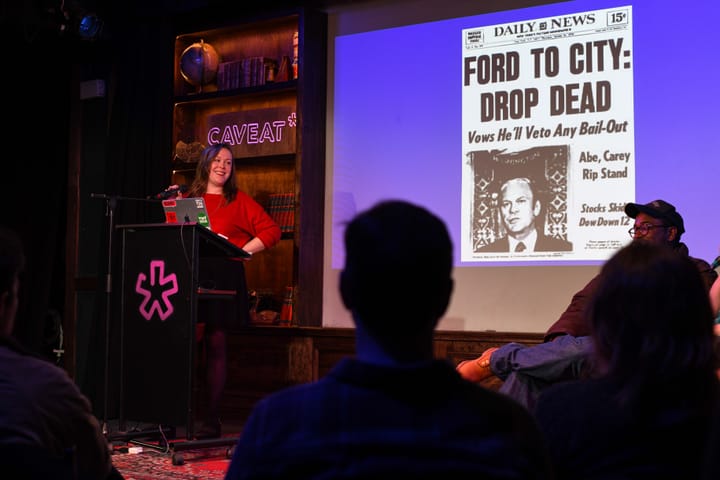
Turns out I’m not the only one thinking about this. Lindsey Cormack, a professor, author and self-described “earnest try-hard” of civic engagement in this city, is working on a book about the topic. I saw her give a talk about it last week called “Alone Together: Effects of Headphone Culture on Politics,” part of the Lectures on Tap series at Caveat on the Lower East Side. Cormack was also a guest on New York Groove Live! this week, where she was filling the audience in on how and why you should join a community board. But I found the headphones talk so striking and moving that I asked her to sum it up a little for us again.
Catch the video of our chat here:
(You can still watch the stream of our show until March 10 here).

The headphones topic also made its way to the New York Times Magazine recently, where writer Conor Truax noted that soon after buying “anti-noise” headphones, he missed a Q train because he couldn’t hear a train announcement. He wondered whether using the headphones to navigate the “crannies of life” — the sidewalk or the grocery store — was a way to avoid the responsibility of being a person.
“In the past, the racket in these spaces was more communal. Instead of the angry disquisitions of a political pundit or a TikTok video about a movie’s underrated ‘spicy’ scenes, we might have overheard conversations about community goings-on, a new favorite movie, someone’s complaints about their life,” Truax wrote. “These conversations still happen, if less often, but when faced with a medley of individual racket, we’ve found it easier to ignore the communal too.”
I am realizing that I don't want to ignore so much any more. I have found myself wondering how many instances of “have a good day” or “nice jacket” I’ve missed by being sucked into my own Spotify playlists all the time; I wonder how many times someone shouted after me that I dropped my sunglasses on the street without even registering it, how many overheard in New York or raw human moments I’ve tuned out. Other people are annoying, but having algorithmically dictated music in my ears all the time is decidedly more so. City life is supposed to be a little annoying, and a little messy. Sure, it's fun to put your tunes on and lock into main character syndrome when you're moving through the city. But, you have to remember, you're not the main character: the story of New York is a classic 8-million hander of a tale. You're going to miss some plot points if you don't pay attention.
Virginia also independently brought this up in Groove Slack this week, wondering how to break the tether to the phone: "I've had the headphones problem for so long that I used to feel really zen and proud of myself for not using my ipod on the train, now it's downgraded to 'feel pleased with myself for listening to something without scrolling at the same time.' "
I left the house for a walk before writing this and, stressed from a night of little sleep, I decided to put my headphones in to finish listening to a podcast about the war in Iran, so that I may better understand what is going on (spoiler: it still doesn’t make sense). As I was about to turn the sound up, I saw a crew of dudes who hang outside the deli laughing and cutting each other up. They put their hands together and in unison shouted “whooaaaaaa Bundy!” It’s a deep cut reference to Married With Children, a show that was very important to my sense of humor growing up (and that I still dabble in today, it weirdly holds up).
I had a real chuckle thinking about what kind of conversation they were having that led them there, how this group outside the deli started joking about a ‘90s Fox sitcom. It made me smile, and feel good about my neighborhood. I can’t say the same about the war.

Comments ()