
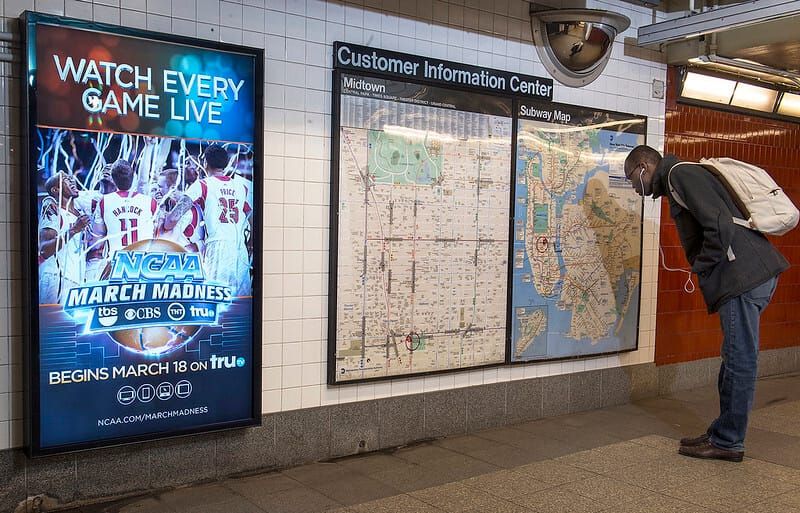
The MTA is actually looking at using those screens for more than advertising
The agency sent out a call for 'next-generation' tech that would make it easier to update riders
Attention passengers, the next stop is: the future?
AI-powered alerts, personalized information screens and public announcements that actually change volume so you can hear them could be coming to subway stations across the city in the coming years. It’s potential good news for anyone who has stared at the platform screens looking for train information only to find viral horrifying recipe videos or ads for a Hulu show instead.
In September, the MTA started the process of bringing its subway system communication into a streamlined, 21st-century operation loaded with new technologies. The agency put out a request for information about ways to incorporate “next generation” advancements in its screens, announcements, wayfinding and technology in the subway system. The goal is to make it easier to alert passengers with exact updates from the MTA’s command center, a process that for years has acted like an imprecise game of telephone.
That request is very open-ended at this point but could include things such as AI-assisted announcements, volumes that adjust based on ambient noise (which would avoid situations like a screaming announcement on an empty platform), personalized trip guidance, platform-specific information, multi-lingual announcements and increased accessibility, like visual alternatives to audio announcements. The unified system would replace the patchwork, often low-tech options for information sharing throughout the system now.

The idea has been part of the agency’s long-term capital plan for the system, but the request for information landed on the heels of a report released by the Effective Transit Alliance earlier this month (which The Groove reported on), saying that extraneous, repetitive and ineffective announcements have gotten “too damn loud” and are creating an assault on riders’ attention.
The group called on the MTA to review the announcement policies and find ways to make important updates actually stand out so it doesn’t get lost in a flood of information.
Blair Lorenzo, executive director of the ETA, said the new MTA effort seems like a step in the right direction.
"We all know how hard it can be to hear announcements on the subway platform, and new speaker and signage technology should really improve the situation," she wrote in an email to The Groove. "I would ask the MTA to focus in particular on the ability of any new technology to better inform passengers of unexpected changes. Trains, for instance, should be able to use their clear, onboard systems to inform passengers about locals running express, reroutes, or any other frequent change without the need for conductors to make often impossible to hear manual announcements."
Europeans, she noted, are "light years ahead of the MTA" on this kind of tech; Germany and the Netherlands in particular update every train and bus stop display with real time arrival info and connecting services.
That kind of ease of travel is the MTA's goal, the MTA’s chief customer officer Shanifah Rieara told The Groove after an MTA press conference Wednesday.
“This is something that our customers have been long deserving of,” she said. “My mandate, and my team’s, mandate, is to improve how we communicate with our customers what is happening with the system at any given time.”
MTA Chair Janno Lieber said the call for next-generation technology was not a response to the ETA report, though the information in it was not a surprise.
“People point out the shortcomings of our existing system,” he said. “We mostly say, ‘you’re right,’ and we’re fixing them.”
The agency has set aside $800 million for this purpose in its 2025-2029 capital plan; proposals are due by mid-October, which will start a long process of updating the communications technology.
It’s a tall order: the subway, with its ancient infrastructure, wide-reaching coverage area and all-night service, presents a challenge for how to distribute information efficiently, Jamie Torres-Springer, president of MTA Construction & Development, told The Groove.
“You look at stations around the world, they have lots of interesting innovations,” Torres-Springer said (he declined to cite a specific city doing it well because he didn’t want to “put my thumb on the scale” for the proposals). “A system at our scale, it’s very challenging to deploy things all at once.”
But before there can be AI-boosted alerts or enhanced video screens, the agency is still chasing out some ghosts from its old technology. Lieber said Wednesday he is still thinking about his “lesser goal to bring the MTA into the 20th century” by eliminating the mumbling, grating “really bad, old-timey public address systems” (he helpfully illustrated the PA systems by placing his hands over his mouth and mumbling indistinctly).
The system still has 72 stations that use that outdated announcement technology, which have not been updated in 40 years and are not connected to the agency’s central Operations Control Center, which makes it hard to distribute information efficiently. The MTA is currently in the process of replacing them, Lieber said, along with antiquated first-generation countdown clocks.
“We are getting rid of those,” he said. “We’re getting rid of the worst of the worst.”
These upgrades also require replacing more than 100 miles of the system's fiber network, first installed in the 1990s, to connect all the Help Points, public address systems, countdown clocks and emergency communications, according to the capital plan.
“We’re looking for those technologies that can help guide customers safely around the platform and the station and give them information about where the trains are and when the next trains are coming that are cutting edge,” Torres-Springer said. “We’re looking forward at seeing what we get back from that.”
The updates would tie into the new version of the MTA app, released in the spring, which the MTA designed in-house (and is actually quite useful for finding real-time train and bus info, imo; the trip-planning function gets less-good reviews). Past MTA attempts at update its tech have not always been a hit: the touch-screen kiosks introduced in 2014 were phased out shortly after).
The subway has already been gradually updating one very analog form of technology: it has been phasing out the practice of using paper announcements taped to walls and pillars to announce service changes, Rieara told The Groove. With improved communication technology, the MTA will be better able to target service alerts where they’re most needed, she said.
“It is not as prevalent across the system as it used to be,” she said. “I should not be in the Bronx when learning about service changes in the far reaching [areas] of the city when I have no hopes or goals of traveling to that point. So we have really been drawing down on that and hope to phase that out.”
There is one physical aspect to the new technology that would still need to be sorted out: all those fancy information screens on the platform are no use if people keep smashing them.
This video board in the Canal Street subway station got damaged and the result is weirdly beautiful.
— Jason Fry (@jasoncfry.bsky.social) 2025-06-12T15:36:53.869Z
Rieara said the agency is constantly in talks with security personnel to come up with new ways to address that; they’re also looking at different materials that could be used in the construction of the screens.
“It is a huge problem,” she said.
Lorenzo noted that any new tech is only as good as the messaging its used for. New tech also opens up the opportunity, of course, for more advertising.
"That would only make the rider experience worse, further pushing people who can to ignore announcements while forcing those who rely on them to sift through an ever-increasing amount of noise," she said. "The best technology in the world is useless if it isn't used in a way that gives riders the information they need while otherwise respecting their time and attention."
 Virginia K. Smith
 Mary Ellen Cagnassola



Comments ()