
The DSA's Eon Huntley wants to animate a better world
'No one person can save us all.'
I chuckled when Dave asked me to cover an anime-themed political event for The Groove. Is my brand too strong? I wondered. My smoke too tough?
However, though I knew about the event, I wasn’t fully ready to iron my Rei Ayanami longsleeve. The Bushwick event was hosted by Eon Tyrell Huntley, a Democratic Socialists of America-backed politician running for office in Assembly District 56, which also encompasses parts of Bedford-Stuyvesant and Crown Heights, a fundraiser to support his primary challenge of Stefani Zinerman. While I enjoy writing and reporting on politics, I’m wary of participating in them elsewhere. Journalism, even the values-driven journalism I pursue, offers some distance. (I wound up attending as a member of the press and without making a donation, for those keeping ethics score at home.)
On the Bushwick-Bed Stuy border hub Wonderville, an indie dive barcade – less Street Fighter, more Icarus Proudbottom’s Typing Party – that sounds every bit like it was designed to break Bill Hader’s Stefon on air, Huntley packed the venue last weekend with a few dozen eager fans, of Eon, of Goku, socialism, free health care, and the form that brought their worlds together. “Anime has some of the biggest properties [in media],” Huntley told me on the phone.“Transforming the world from the capitalist hellhole that we live in requires you to imagine a world that doesn't exist yet.” In that sense, the fantastical themes rendered in anime are the perfect adhesive for connecting to a deeper, collective politics.
Huntley told me he’s been thinking about this event since shortly before he lost his 2024 campaign against Zinerman, then a two-term incumbent. From his youth browsing Royal Video in Canarsie for Fist of the North Star tapes, Huntley is an anime lifer, a fact he only revealed to a fellow anime-loving staffer late in his last campaign, by then too late in the game to program an event centered around his interests. It may be unlikely that an anime fundraiser would have secured the 517 votes Huntley needed to topple an institutional Democrat backed by Brooklyn power brokers like then-Speaker of the House Hakeem Jeffries. But in round two, Huntley isn’t taking any chances in finding every possible way to forge a deeper connection with new voters, donors and evangelists. He partnered with Anitomo, a free anime conference in Brooklyn that offers a contrast to the nerd-conference scene’s commercialized lean.

From the outside and untrained American eye, anime is unlikely to be associated with more than stilted dub dialogue and screams that last the entire length of the episode. (That’s because a lot of anime is, and it’s awesome.) But, the featured speakers who joined Huntley’s event – each of them equipped with tongue in cheek powerpoint-style slides and sly nods to the fandom — encouraged people to treat these stories as more than just hyperserialized action cartoons for boys (called “Shonen”) but a serious art form worthy of engagement, and from there, able to provide the raw material for leftist thought.
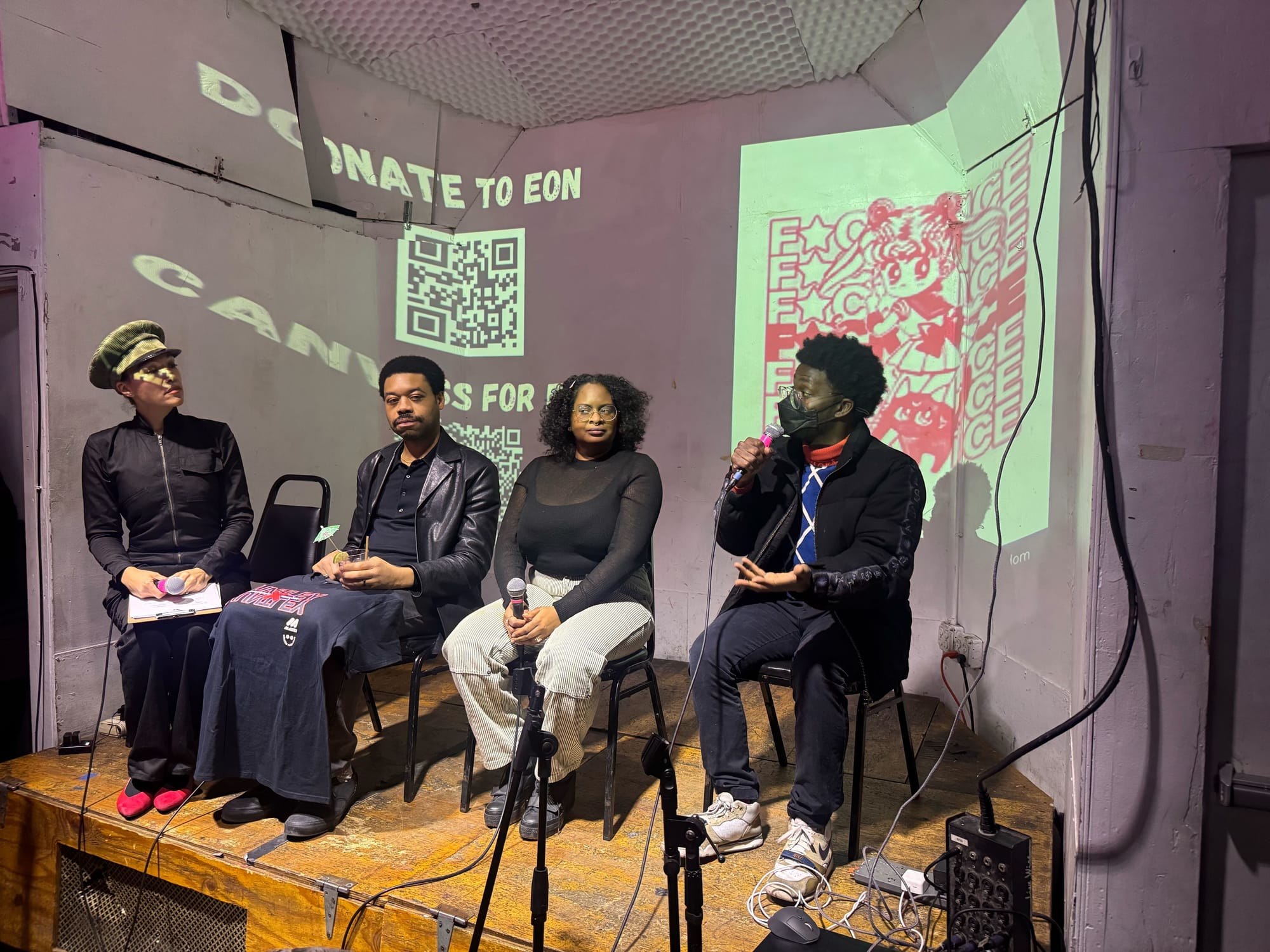
Content creator and humorist Christian Divyne mined Fullmetal Alchemist for insights into the potential of restorative justice and the military industrial complex, noting how Colonel Mustang, one of the main heroes of the show, is also a war criminal who willingly relinquishes his power and subjects his desire to be tried in court for those he’s harmed. “[In Fullmetal Alchemist], native people get their lands back and oppressive nations are no longer allowed to stock massive weapons,” Divyne said, “It is the most in-depth anime you can watch about this.”
Chi Osse, a City Council ally of Huntley’s who was admittedly not the same caliber of anime fan as the other speakers, nonetheless compared the oligarchy to the Akatsuki villains from Naruto. “A secret, but not really that secret, squad of evil villains that are aiming to dismantle everything that we care about.” (Osse’s talk was more of a cameo. He had to head to a Manhattan anti-ICE rally galvanized by that morning’s killing of Alex Pretti in Minneapolis.)
Gita Jackson, a journalist and cofounder of worker-owned gaming site Aftermath, explored the shojo genre (literally “young girl,” it is shonen’s feminine compliment) with a particularly poignant explanation of how Sailor Moon influenced their feminism and queerness. Arguing that the heroic Sailor Scouts, a team of five girls powered by the magical properties of the solar system (just go with it), protect victims from villains who frequently prey on girls by wielding capitalist symbols of feminine success: jewels, makeup. “The show does not judge people for being suckered in by those markers, but they always frame it as exploitative,” said Jackson from the front stage. It’s not explicitly feminist” Jackson admitted. “But we always see Usagi [Sailor Moon’s secret identity] saying, I need to protect young girls from being exploited by the world around them. That was a deeply radical thing for me to hear as a kid.”
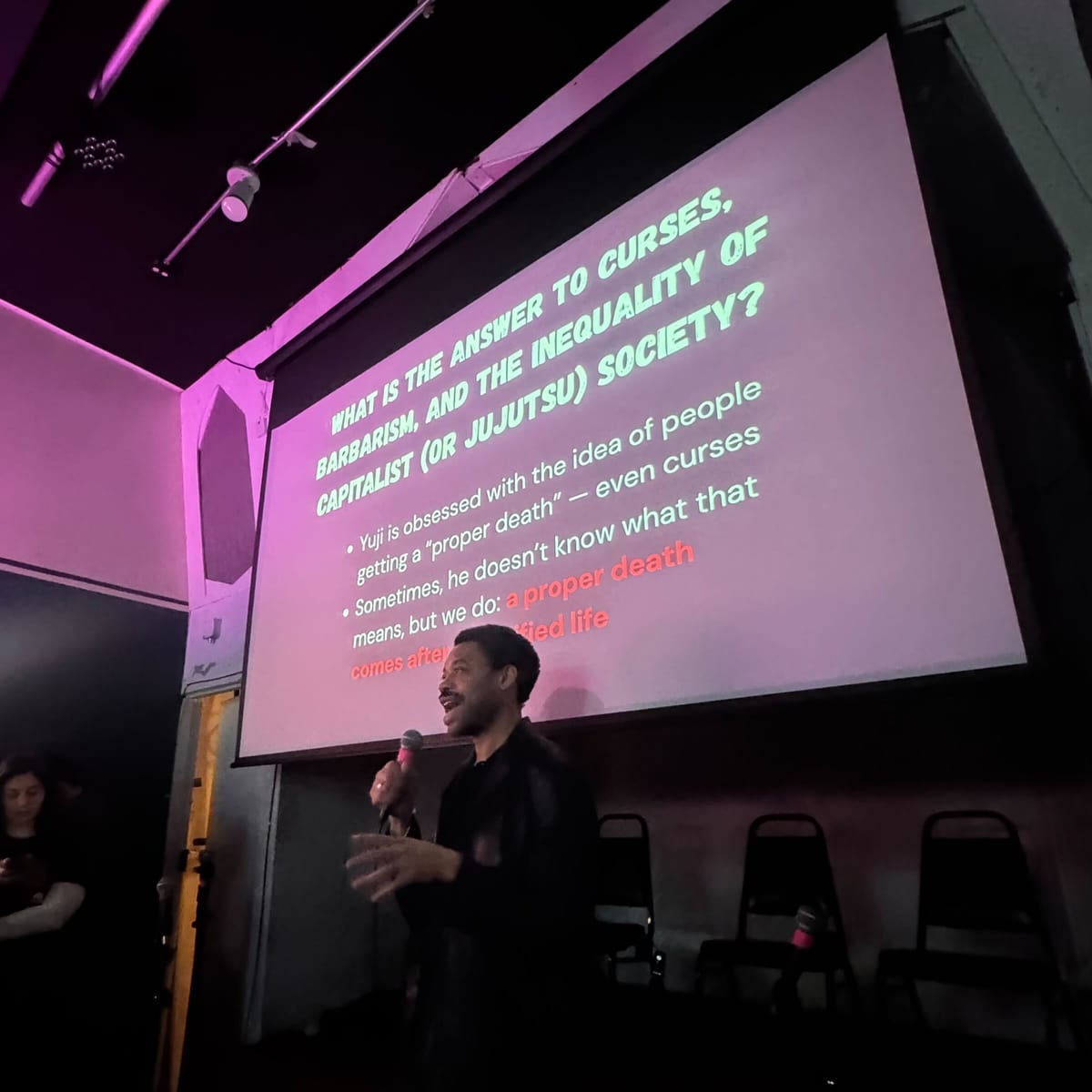
Huntley himself argued from the stage that Jujutsu Kaisen subverts the typical hero’s journey of accumulating and discovering new thresholds of power to defeat escalating forces of evil. “Not to drag my guy, I love Goku but [Jujutsu Kaisen hero] Yuji Itadori doesn't think of himself as solitary. But ultimately, he wants to collaborate, to be a comrade, to be cadre," Huntley said,
“All the victories [in JJK] happen in conjunction with others,” Huntley told me. “[Yuji] may be someone that's singularly and uniquely powerful, but that singular uniqueness is within the space of others. Its heroes are only able to prevail with the support of each other.” The aspiring assemblyman sees the same theme in Marxist thought. “No one person can save us all.”
This feels like a good time to again discuss why I’m here. Not just at Wonderville, but here, meaning, New York City. Despite being a native of the five boroughs – half Queens, half Harlem – I recently spent a year on a sidequest of sorts in Texas, covering politics and culture as a columnist for the Fort Worth Star Telegram. Though I always hoped to return to New York, I loved exploring the inner folds of a city with one million people in the largest Republican-led county in the U.S., yet with growing pockets of community resistance against the collateral damages of MAGA governance, one the country is finally seeing manifest through the victory of Democrat Taylor Rehmet over a moneyed religious extremist in a typically deep red district.
Writing for the North Texas region wasn’t a thoughtless filler arc for me, but a canon event. As a columnist, I had more freedom than most to express my interests and values through my reporting. One of my favorite columns was about Wael Tarabishi, a young disabled man whose father and caretaker, Maher, was indefinitely detained by ICE. When I spoke with Wael, who was bedridden with tubes running in and out of his body, I noticed he had a Goku poster on his wall. We ended up rapping about his love of anime. I found deep resonance between Wael’s relationship to Maher mirroring the strength Goku imbued in his son, Gohan, to face his toughest battle for the fate of the world. Sadly, Wael’s health declined precipitously after Maher was arrested, and he died on January 23. The Department of Homeland Security refused to release him, even conditionally, to bury his son. Though Wael wasn’t shot in his car like Renee Good, or on the street like Alex Pretti or Keith Porter Jr., the Tarabishi family believes that if Maher wasn’t locked up, his son would be alive. I do too.
I speak about my time at the Star-Telegram in past tense because I was laid off in November. The respect and growing audience I acquired from dignifying the lives of Fort Worth’s racial, ethnic and religious minorities was crushed by the apparent omnipotence of capitalism. (I wish my former employers well in their pursuit of AI generated news stories.) I didn’t believe one great blog, on its own power, was likely to save Wael. But when I was told my column about the Tarabishi family would be my last, I learned, the hard way, that good blogs couldn’t save my job either. Put another way, it was a rather painful subversion of my shonen arc.
Which made Huntley’s emphasis on building collective power, a necessity, not an option, all the more compelling. Gadflying, whether out of my own risk aversion or the self-imposed handicaps fourth estate in its present form, cannot disrupt the forces of darkness. We can’t all be community organizers, but fighting alone isn’t enough.


Comments ()