
Madison Square Garden spies on fans. There's a budget crisis. Why does MSG still not pay property taxes?
'There's no reason that the status quo should persist. Their success is welded to New York City.'
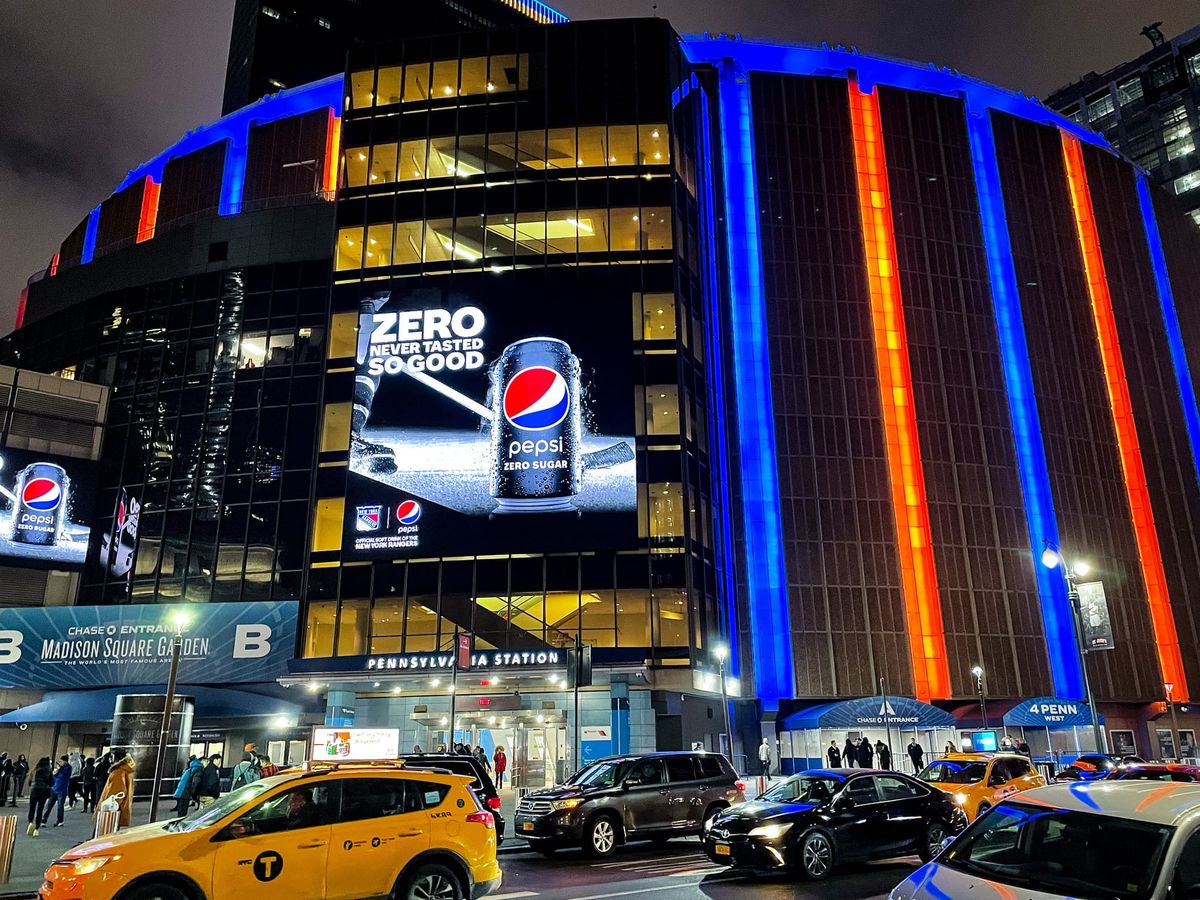
It’s a boom time for Madison Square Garden these days. The Knicks are the toast of the town, widely seen as a NBA Finals favorite, while the Rangers are … well, we don’t have to get into details, but the idea of the team is still drawing sellout crowds as well, even as fans are subject to wildly invasive surveillance when they go see a game. Life is good at the World’s Most Famous Arena, and that’s before you even consider that Madison Square Garden Entertainment, the company that owns MSG, has avoided paying tens of millions of dollars in property taxes to the city every single year for the last 40 years. What gives?
For 44 years now Madison Square Garden has been exempted from paying property taxes to New York City. The arena has been the only sports venue in the city that’s able to skip out on the bill since 1982 thanks to a poorly thought-out bit of panic legislating last century, despite the fact that it sits on ludicrously valuable land smack dab in the middle of Manhattan on top of a thriving mass transit network that makes it easy to get to and from games and concerts.
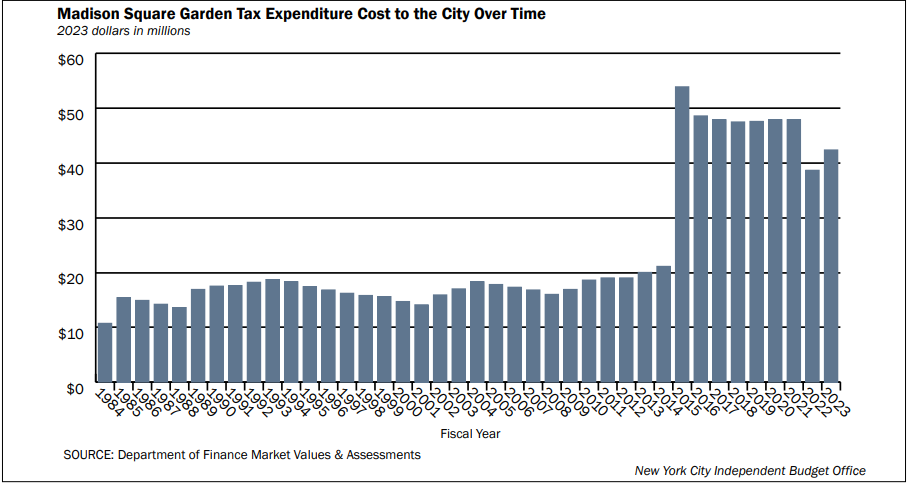
A 2023 report from the city’s Independent Budget Office put the total amount of unrealized tax revenue from MSG at a staggering $946.7 million between 1984 and 2023, and estimates from the city Department of Finance since the report came out push that number over $1 billion in total. Since 2015, the city has been losing out on over $40 million per year in property taxes.
“Look, everyone should pay their fair share, including Madison Square Garden,” said Manhattan Borough President Brad Hoylman-Sigal, who, as a state Senator, represented the district where MSG sits, and who proposed eliminating the exemption in 2023.

Support independent local journalism. Become a member of The Groove today and you will unlock perks, discounts and more!
There’s an impunity to the way the arena management avoids its obligations, a self-awarded license to act outside the norms that was driven home recently when Groove contributor Robert Silverman followed up on his New York Groove story about MSG’s alleged surveillance activity on fans inside the building with a piece for WIRED that delved even deeper into the panopticon built at the behest of arena owner James Dolan.
It’s well-known at this point that Dolan has used facial recognition databases to bar unfavored patrons from the venues he owns, but the WIRED story dug deeper into a culture of harassment and surveillance that would fit in well in East Berlin. Per Silverman and Noah Shachtman, MSG management has used its network of cameras and security agents to keep minute-by-minute tabs on a transgender fan who just liked going to Knicks games, put fans who chanted “Sell the team” during losses into a facial recognition database and monitored social media criticism of Dolan’s stewardship of the Knicks and Rangers.
But even if it were the case that everything going on at MSG were on the level, the tax exemption is a patently ridiculous continuation of a policy that plenty of people found ridiculous at the time it was instituted. According to the IBO report on the tax break, in 1982, the owners of the Knicks and Rangers suggested that they would be willing to move the teams to the Meadowlands because it was too expensive to own and operate the teams in New York City.
Even in 1982, some legislators said the argument was dodgy, but at a time when the city was still dealing with the fallout of deindustrialization and the 1977 fiscal crisis, “giving tax breaks to successful industries” won the day. Legislators, and then-Mayor Ed Koch, also thought they were only giving the Garden a tax exemption for 10 years, not in perpetuity. Reading comprehension is so important.
In 2026 though, it is beyond absurd to believe MSG needs a tax break to remain competitive. As the IBO report notes, both teams have benefited enormously from playing in, and being closely associated with the media capital of the world. Despite the premise of the 1994 cinematic classic Eddie, where a scheming owner plots to move the Knicks to, uh, St. Louis, the NBA and NHL would also be extremely skeptical about letting two historical franchises so closely associated with New York move to a different, lesser city where Timothee Chalamet would be significantly less likely to squire Kylie Jenner around at courtside.
“There's no reason that the status quo should persist. It was about the Knicks moving, perhaps to another state. Now that is not possible. Their success is welded to New York City,” Hoylman-Sigal told The Groove.

There’s also the issue of the city’s precarious budget situation. Mayor Zohran Mamdani and the City Council are still figuring out how to fill a $5.4 billion budget gap by the end of June. Some help from Albany appears to be incoming in the form of a pied-a-terre tax and other state aid that Governor Hochul is floating for the city, but no one is walking through that door with a giant novelty check made out to the city treasury.
Property taxes make up almost one third of the city’s annual budget, and are also the one form of taxation that the city has under its direct control (raising things like sales or income taxes requires approval from Albany), so it’s no small potatoes that every year MSG manages to duck paying tens of millions of dollars to the city.
The IBO pointed out in its report that MSG is the only sports venue in the city that gets a full-on property tax exemption, though stadium management has made the case that it’s hardly alone in dicey financing deals. Citi Field, Nu Yankee Stadium and the Barclays Center all have dodged property tax payments in their own way, through the use of payments in lieu of taxes, which are used to pay back the tax-exempt bonds used to finance stadium construction.
The property tax exemption is hardly the only tax exemption handed out in the city, but it’s a rare exemption given with zero strings attached and with no sunset date on the books.
Because Albany created this mess, the state capitol needs to fix it. And it’s unclear how many dollars the state is willing to see the city forgo in taxes and for how long before someone finally puts a stop to it. A bill to end the tax exemption has been floating around the state legislature since 2013 but it has never gotten out of committee in either the Assembly or state Senate. The handful of sponsors have kept at it though, including Assembly Member Tony Simone, who currently represents the Assembly district where MSG is located.
“Assembly Member Simone has long been a co-sponsor of legislation to remove this exemption,” said Simone spokesperson Jacob Golden. “There is no public benefit to a multi billion dollar corporation not paying property taxes on some of the most valuable land in the world.”
Of course, the politics of unwinding the tax exemption were already tricky enough when elected officials could be swayed by campaign contributions from Dolan or intimidated by a round of bad press for “attacking a job creator.” Adding to the difficulty of finally tweaking, if not even outright eliminating the exemption is the fact that the Knicks have climbed out of the pit of irrelevance and humiliation they lived in for most of the 21st century, which makes taking potshots at their flinty owner less of a political winner these days.
“I really think the Knicks have, to some extent, made [Dolan] invulnerable to public critique, particularly during budget negotiations," Hoylman-Sigal said, adding with a laugh: "Maybe if the playoffs weren't in late April it would be a different scenario."

Comments ()