
Busking is as old as public space itself; can it survive the Venmo economy?
BuskerBall is a reminder that supporting street music is easier than you think
Answer our Question of the Week about buskers too!
Be honest. When was the last time you took your headphones out to give your full, undivided attention to a busker? Did you toss a couple bucks to the pianist in the park? Or clap for those guys that parkour across subway cars, swinging from the bars inches from your face to the beat of EDM blaring from rainbow-light speakers? Did you at least make eye contact or nod your head in acknowledgement?
This past Saturday was a good reminder of this for anyone passing through Tompkins Square Park. Some signs around the periphery read “You didn’t expect to see this today!” and pointed passersby toward the south side of the park, where a tall American elm grows before a wide semi-circle of benches, shading the circular plaza. Here, BuskerBall was taking place: a free event celebrating busking with an all-day line-up of performers. I stopped by to check it out and ask buskers how they’re faring in an increasingly cash-free and music-streaming-platform driven world.
It was a fitting place. This very elm is referred to as the Hare Krishna tree, where Swami Prabhupada, the founder of the Hare Krishna movement, and his followers first sat to chant and play cymbals and tambourines for hours in 1966. (Basically, they were buskers.)
Theo Eastwind, a long-time musician and busker himself, founded BuskerBall in 2013, in response to Hurricane Sandy. Eastwind got a bunch of buskers that he knew together. “We were like, New York has given so much to us. Let's give back,” he said. “We raised about $10,000 for the Red Cross.”
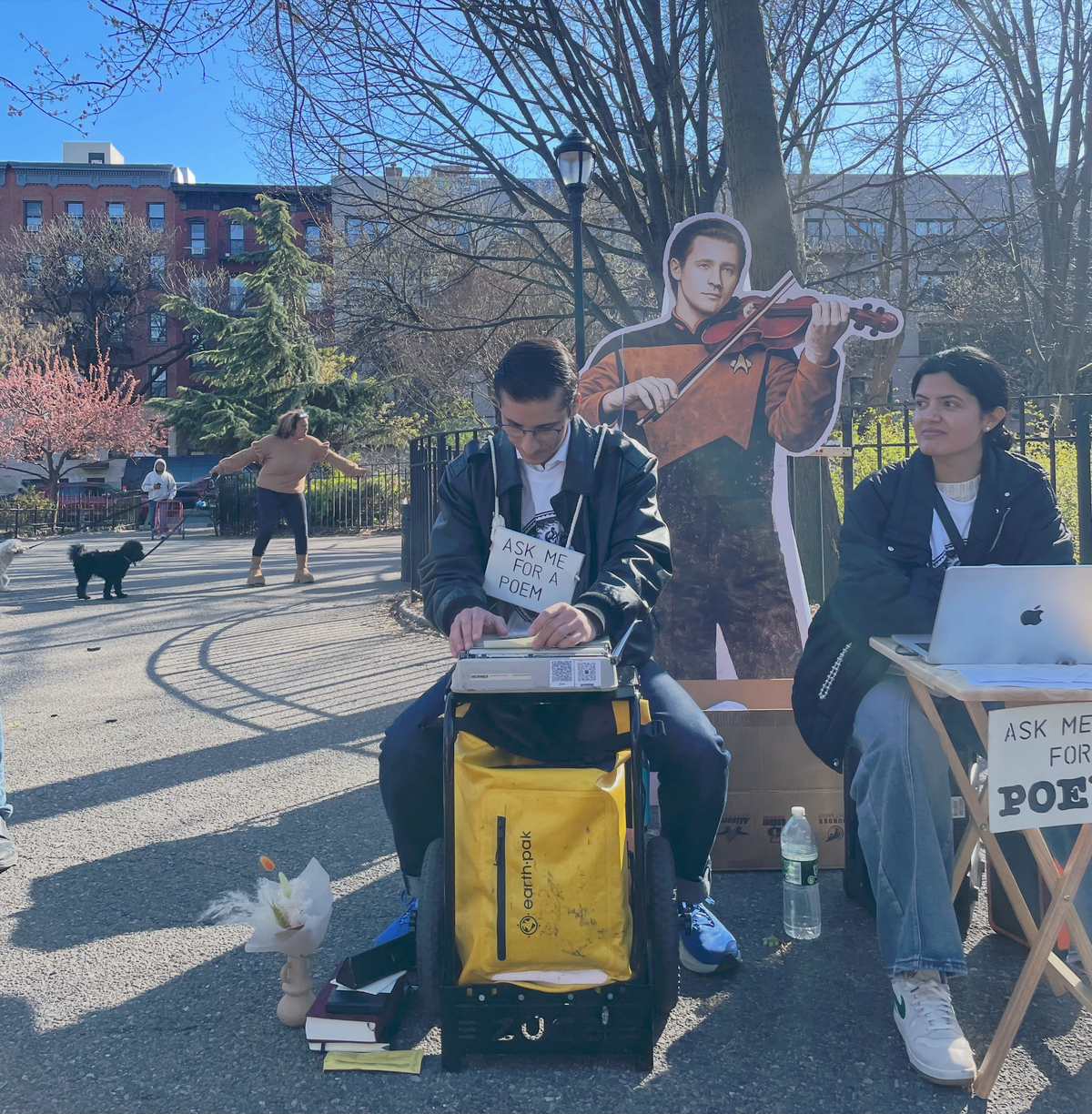
This year was the seventeenth BuskerBall. Now, it’s more focused on paying buskers, creating space for connection, and cultivating appreciation for this artform. The day’s 10 performers and artists included a man playing a didgeridoo — occasionally punctuating the drone with words that echoed, like “New York‑ork‑ork‑ork!” — while drumming on a cajón; a dancer whose black‑painted hands and feet left a map of her movements across a large square of white paper; a veteran musical saw player; a spontaneous typewriter poet; a Gambian kora player; and a balloon artist twisting long balloons into flora and fauna for excited kids.
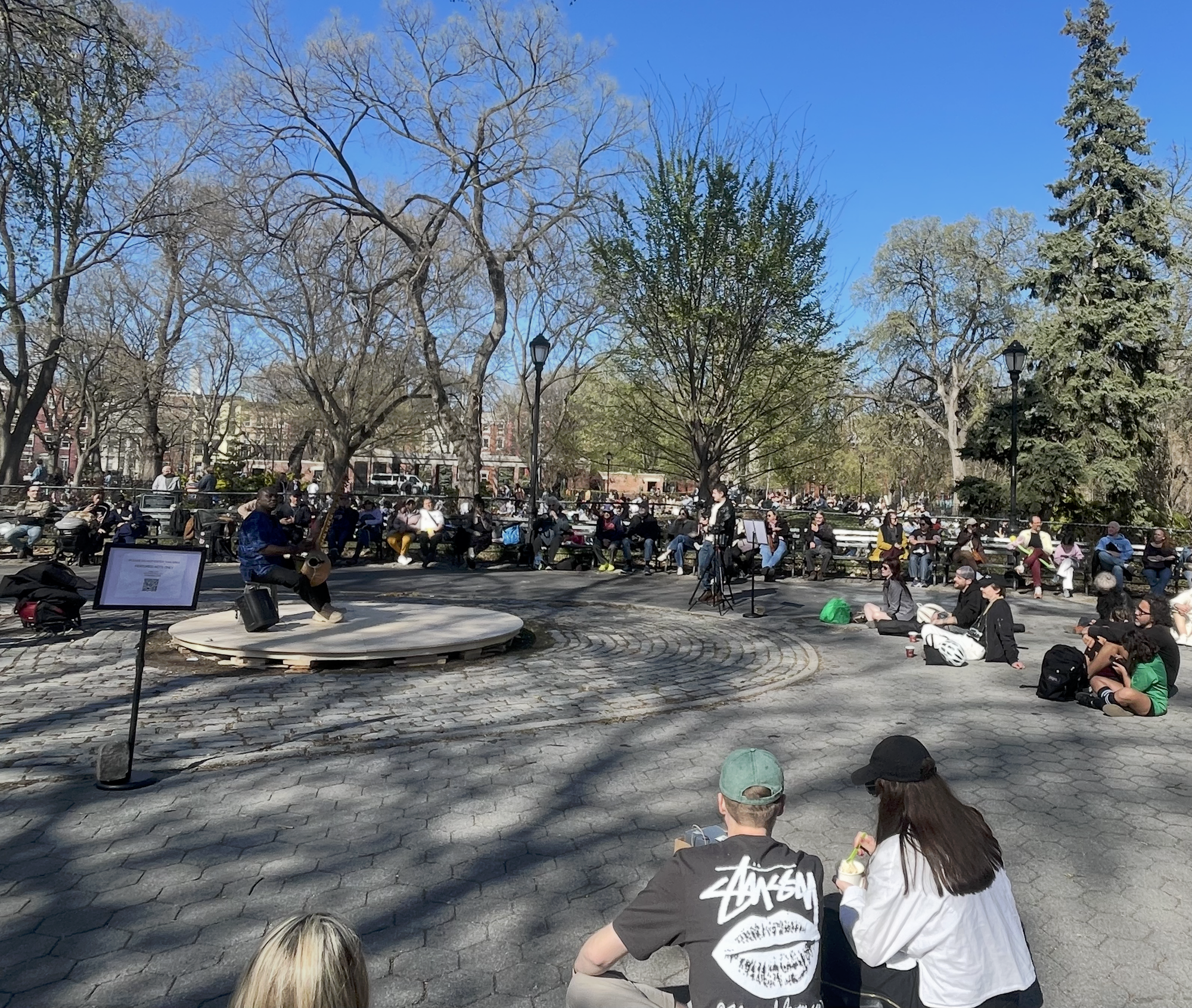
Between sets, Eastwind would make announcements into a microphone, notifying people about the next act, enthusiastically advertising a raffle where the winner would get to share some pizza with a stranger, and gesturing toward an exhibit of plaques detailing the history and importance of busking.
🎺 Shaking our own cup (and tooting our own horn) to remind you that this site is owned and run by journalists and entirely funded by our members. Consider joining us for as little as $6 a month and you'll unlock perks, and keep stories like this coming every week.
As old as public space itself
The term “to busk” comes from the Spanish word “buscar,” meaning “to seek out” or “to look for.” This simple act, of performing in public for money, is ancient. There were street performers in ancient Rome, Greece, Egypt, and India. During the Middle Ages, jugglers, acrobats, and musicians entertained the public. From the wandering storytelling troubadours of France, to Benjamin Franklin singing on the streets of Boston as a young boy, to the Mexican mariachis that still sing in plazas, busking is as old as public space itself.
Despite its rich history — and the countless success stories of artists like Ed Sheeran, Tracy Chapman, Rod Stewart, and George Michael, all of whom started out on the street — busking has long been stigmatized. When millions of immigrants arrived in New York City at the turn of the 20th century, they brought their own performance traditions with them, often turning to the street to earn a living. By 1935, the city banned street musicians altogether, effectively casting them as beggars. It was the New Deal era, and the country was reeling from the psychic and economic devastation of war.
Like many leaders of his time, New York City Mayor Fiorello LaGuardia was intent on progress and modernizing the city. That mission included, among other things, an anti-noise campaign. One that street musicians, by definition, violated.
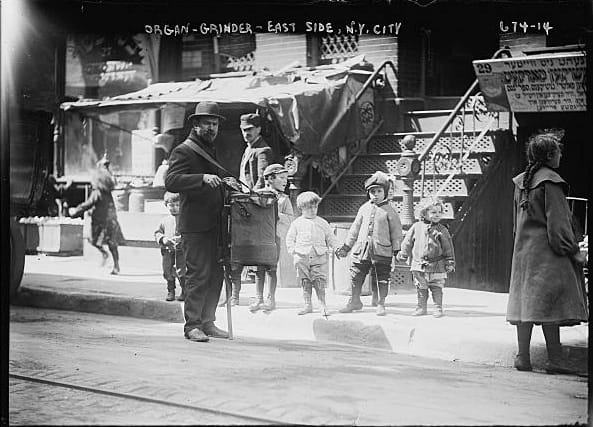
Though many New Yorkers wrote to the mayor in protest (one scolded him, “I had hoped you were a man and not a sissy”), the ban remained in effect until 1970, after Allen Ginsberg, the beat poet, and other artists challenged it.
Knowing all of this, Eastwind’s most frequent refrain to the public at BuskerBall this year — “Buskers are the Jedi of the First Amendment!” — doesn’t seem like such a stretch. Buskers are on the frontlines of free expression and the perennial fight over who public space is for. I think of John Berger, who once said: “For me, a storyteller is like a ‘passeur’ (a smuggler) who gets contraband across a frontier.”
Throughout the day, I watched as these performers attracted all kinds of people: tourists, students, skeptics, families on their way to brunch, parents with strollers, toddlers willing to sit on the ground, and older folks who watched from benches for hours, tapping their feet. On more than one occasion, someone walked through the area without stopping to assess the hubbub, but all while shaking their head or bouncing their body to the beat of the music being played. They maybe had no intention of stopping, but their individual path was nonetheless literally altered by a momentary, shared experience.
Take it from someone who enjoys solitude enough to go days without speaking to another soul and not notice: one of the things I love most about this city is that it constantly pierces through the kinks in my defenses and reminds me that hell is not other people. To me, buskers are the most reliable proof of the opposite.
(Video by Alesandra Tejeda)
Or, don’t take it from me. Here’s what some of the artists I talked to at BuskerBall want you to consider:
Carry cash people!
For Eastwind, giving a dollar to a busker is like a gesture of pure democracy. “You're telling them, ‘Thank you for defending my right to express myself in a public space,’ right? This is very important for us to have that outlet. Not everybody wants to be famous, not everybody wants to work in a job. Like me, I'm much happier when I am in control of my life and busking.”
It’s worth noting that Eastwind doesn’t live off what he earns as a musician, though he used to. He started busking in the city in 1995, after immigrating from Vienna. The transition was difficult, he couldn’t find a job, and couldn’t get papers as a student. “Busking saved my life,” he told me. “Mentally, physically, it was the best thing that ever happened to me.” He used to survive off of tips from singing in the street and CD sales. When the latter fizzled out, he became a real estate broker.
Natalia Paruz, a.k.a The Saw Lady, said she also can’t afford to busk as much as she used to. When she first quit her job in the ’90s to busk full-time, it paid the bills. Now she and other street performers she knows have to balance it with other gigs. Paruz says the pandemic was the turning point. “I have the Venmo sign and the PayPal, and people do use it, but not nearly as much as they used to when they had cash.”
Cash is also more intimate. “If you're walking by and you throw cash into the bucket, you're making eye contact. And it's like this exchange of energy,” Paruz said. “When you're just doing it through your phone, through an app, it loses momentum. So people do it a lot less. That's unfortunate.”

Speaking of screens …
To honor that connection, try to enjoy the performance before you take a photo or video. But if you do and post it, tag the artist. And if you're not putting it online, Paruz said, “then take our card and email it to us, you know, like a souvenir from our act. That would make our day.”
“We give our performance for free to be enjoyed in the moment. But if you take a picture or a video, then you're taking it with you. So that's not part of the original deal, right? So if you take it with you, whether you do something with it or not, it doesn't matter. The ‘payment’ is if you share it with us.”
No cash? Make eye contact!
If you’re not able to spare some change, that’s all right. Show your appreciation in other ways. Say thank you. Write a note to place in the busker’s guitar case or tip bucket. Send them a message on Instagram.
“Because that gives us energy, that gives us the joy to continue sharing. You know, it's like busking is an exchange of joy, basically. So we give ours, you give yours back to us, and it doesn't have to be with money,” Paruz said.
If you’re listening to music through your headphones and don’t have long, "it's really cool if just for a moment, as you pass them by, you take out your earbud as a gesture of acknowledgement, like saying, ‘Yeah, I see you're you're playing music here. I appreciate you contributing music to the world. That's all.’”
Go busk!
Anybody can. You just have to respect some rules. If you’re in the subway, the MTA has some regulations, including where you can set up (you can’t block people’s obvious pathways, like in front of the stairs or elevator, for example) and how loud you can be. If you’re using a sound device, like an amplifier, or want to set up in a park, you’ll need a permit.
Eastwind also has some rules of engagement for busking. Be polite and considerate of other buskers. Keep it moving, don’t depend on just one location to busk. And if you and someone else are trying to set up in the same spot, you'll have to talk it out and negotiate about time and space.
“You just have to understand the rules of the street,” he said. “If somebody continuously sets up on you in the same place, you gotta confront them. You gotta have a street fight. After, you’ll be best friends and respect each other.”
Apparently, this actually happened to him. In the late ‘90s, Eastwind once had to confront the famous Larry Wright, the “original” New York City bucket drummer, who kept setting up near Eastwind’s spot at the 42nd street subway station, drowning out his music with his drumming.
“We beat each other bloody,” he said, “and then we were exhausted on the platform laughing together.”
They hug when they meet now.

Comments ()