
The Schneps Media Union is fighting for newsrooms that last
Turnover is high at the city's largest newspaper chain: 'There's not much in the way of institutional knowledge.'
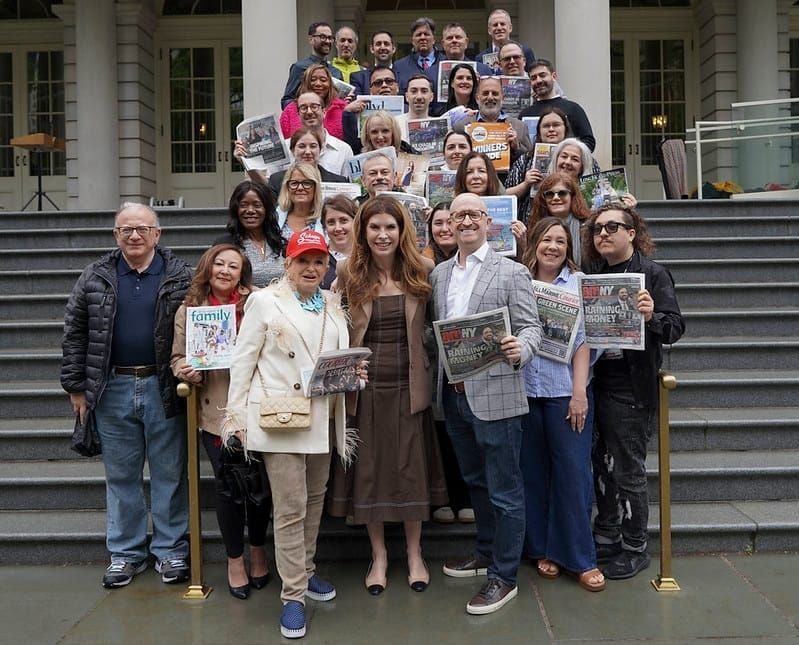
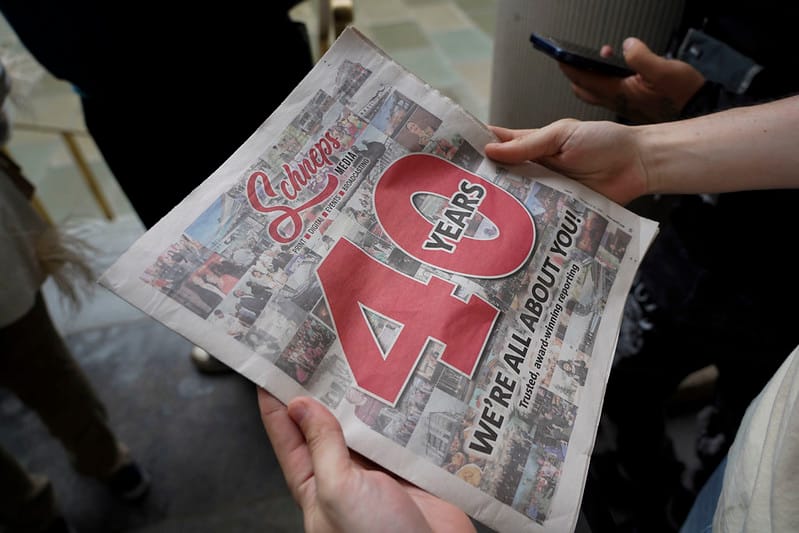
Schneps Media is the largest chain of local newspapers in the city, with arms in all five boroughs, branches on Long Island and footprints in the Caribbean, queer and Spanish-speaking communities. It produces the only newspaper you can pick up for free on the subway, amNY, the often-pulpy and fun Brooklyn Paper, and 30 other hyper-local neighborhood outlets. Yet still, with starting salaries as low as $37,000, and longtime reporters struggling to make a living, it’s hard to keep anybody around.
“There's been a ton of turnover at Schneps,” Ethan Stark-Miller, a reporter at Schneps-owned amNewYork, told The Groove. “There's not much in the way of institutional knowledge because of that.”
The fight for the right to institutional knowledge is a key part of why the editorial employees at the family-owned company decided last month to unionize with the NewsGuild. The employees said Schneps has since denied voluntary recognition and the workers will now go to a union election on July 24. The 27 eligible workers cite the company’s unrealistically low salaries and occasionally flimsy ethical standards among the many grievances they’ve dealt with. But workers I talked to also want the right to a good working memory that is essential for a strong newsroom.
“It was just getting increasingly difficult to live on this salary, and I think, tied to that, there's really high turnover,” said Kirstyn Brendlen, digital editor of The Brooklyn Paper. “People are leaving.”
She understands people jumping to other reporting jobs, even within Schneps, for a bump in pay, but she also mentioned two coworkers who left in recent years without gigs lined up because they couldn’t afford the city, and ended up living with family. “Then, at Brooklyn Paper, we're losing people who are well versed in what's going on.”
At the Schneps-owned Bronx Times, reporter Emily Swanson said she had to lobby for the paper to hire staff who actually lived in the Bronx.
“That has never been prioritized before at this paper, even though it has at other publications,” she told The Groove. Swanson felt called to the public service of local news after careers in teaching and restaurants. She said it took months of asking to get her salary up to $44,000 a year; she pays $850/month for health insurance on top of that.
“Even though I really love what I do and I'm very dedicated to reporting in the Bronx, this job has permanently set me back financially,” she said. “Specifically at the Bronx Times, we've lost really good reporters recently to other outlets that pay better.” They’re not going to other outlets in the Bronx, instead leaving town for Philadelphia and Rye. “People have left, not because they didn't like the work, but because they need to get paid more.”
Become a member of The Groove for as little as $6 a month now to support our work and unlock perks like the FOMO Calendar!
Constant churn and overworked editors means every new hire needs to spend time to get up to speed on the coverage area; it also means fresh meat for hacks and flacks to try their tricks on that manipulate public narrative. Newsrooms used to be built on expert institutional knowledge, people who knew their beats and outlasted politicians. Those long-tenured reporters could help with sourcing, history of the issues or just spotting the cranks who always speak up at a public hearing. It’s helpful to have someone who remembers when a bill was first proposed or which community groups shot down a traffic calming project.
There is a quote that I think about all the time from longtime city reporter Katie Honan, after another bold campaign to unionize DNAinfo and Gothamist in 2017: “If this is the future of journalism, it should be a career for people, not a postcollege hobby.”
Mayor Zohran Mamdani issued a statement of support for the union. Emailed for comment about the union and the institutional memory question, CEO and co-publisher Josh Schneps responded:
“Permit me to save my remarks at the moment for our employees who are considering whether a union will advance their careers or place further economic stress on media outlets seeking to employ the very same journalists.”
Schneps started out as a relatively small chain of free-at-the-supermarket-style community papers, plastered with grip-and-grin photos on the cover and packed with legal listings, based out of a living room in Bayside, Queens, until about a decade ago. That’s when Josh Schneps, son of founder Vicki Schneps-Yuni, went on a buying spree, grabbing dozens of local publications including some major ones, like Long Island Press, Brownstoner, and free subway papers amNY and Metro.
The last two raised some eyebrows at the time: Schneps bought the two papers, gutted the staff of both and combined them into a frankenbeast known as amNew York Metro (it’s now just amNewYork again). Full disclosure: I worked for Schneps for about one year, when the company bought Brokelyn in 2016. The company later sold that site.
"They want us covering things that I think most companies would not have their own reporters cover.”
Like its community newspaper roots, the company’s products are often very advertiser-driven. Beyond the news outlets, it has a slate of advertiser-padded specialty magazines and a roster of live events and Best Of contests that exist as advertising bait for local businesses.
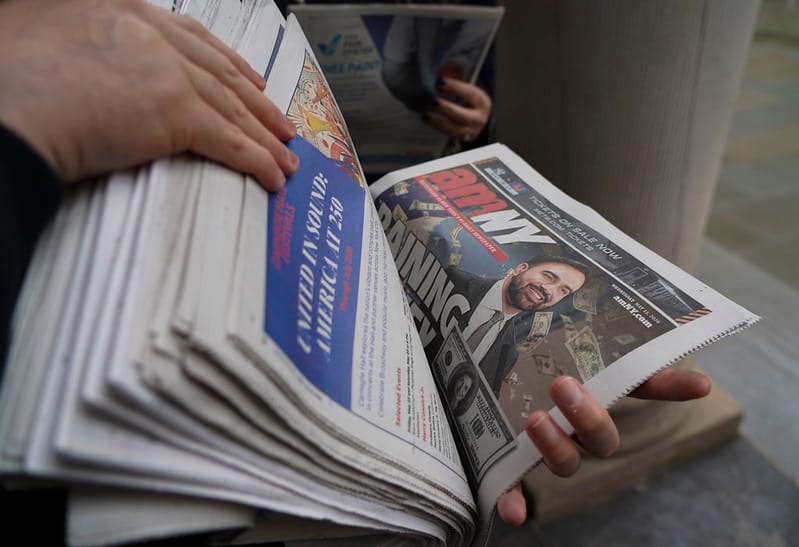
The company and founder Schneps-Yunis have been criticized as being overly glowing to politicians, advertiser-friendly and Adams-friendly too. The last gripe included getting into an ouroboros of corruption by printing an Eric Adams “pseudo-newspaper.” Reporters at the company are sometimes asked to do a favor for an advertiser, the employees told me, or straight up tilt the narrative. They want a union to fight against this kind of editorial meddling.
“Part of what they have us do is promoting their personal views,” Swanson said. “So that's why we have a lot of concerns within this company about editorial independence and the kind of assignments that we are often given. I think they do sincerely value the normal types of stories that we do, but also they want us covering things that I think most companies would not have their own reporters cover.”
Stark-Miller said he takes the Schneps at their word that they go into this business because they care about local news. But the growing pains of its newspaper buying spree are apparent.
“The infrastructure never really caught up with the actual size of the company,” Stark-Miller said. “They're still operating as if they are just like one small paper, when they grew to be a lot bigger than that.”
The distance between boss and actual worker is the bane of many a union-seeking employee: Schneps journalists noted that Vicki Schneps seemed to be in Palm Beach more than in New York, especially at one glorious corruption palace in particular.

“They're not putting the resources there for us to be able to report local news to the best of our abilities, and a lot of stuff falls through the cracks because of that,” he said, citing staffers who are doing double duty as layout and copy editors. “I think we just end up kind of in a position where it feels like journalism is not prioritized a lot of the time.”
There is sometimes a perception that the city’s local media outlets tend to be staffed by the young and freshly-out-of-college, who serve as a feeder system for the bigger papers and outlets, locally or nationally. But some of those jobs are already the big time: a single City Council member represents 150,000 people, more people than Savannah, Ga. or Waco, Texas, both of which have their own dedicated newspapers. Only two Community Boards represent fewer than 100,000 people.
Managing that kind of coverage on $50,000 a year can burn people out fast. To maintain journalism and reporting as an actual profession, it has to be something you can realistically do as a job for a long time.
“Connections are a big thing, and just knowing, like, who can I reach out to, who can talk about X topic, who really knows about it?” Brendlen said. “Because it's not always easy. If you … need to get in touch with people who live in a certain neighborhood or who have been affected by the bus being rerouted; some of the people who were here for a long time probably had phone numbers, but they're not here anymore, and I don't have access to their Google spreadsheet, I don't know where it is.”
Stark-Miller, Swanson and Brendlen were surprised to realize they were each among the longest tenured employees at their publications. Brendlen is fine with that and settling down into that role at the paper. But she’s also trying to settle down in other ways; she recently got engaged and is looking at wedding costs. For now, she’d take a new rug for the one-bedroom apartment.
“But it feels like an unnecessary expense, you know,” she said. “I’m just constantly aware of what's in my bank account.”
She hopes all her knowledge of local topics not many others are going to write about — like the Gowanus Canal — doesn’t go to waste.
“I've written so many [Gowanus Canal] stories over the years that now when people ask questions, or even when I see other coverage of it, I'm like, oh, I know that's not right, or like, that's not quite it,’” she said. “I know it because I work with this hyper local paper, and I've been covering it so deeply for so long.”


Comments ()